Showing posts with label change. Show all posts

Wednesday, 8 December 2010

Dreams for Kids: Holiday for Hope

1 comments

Dreams for Kids is proud to celebrate its 21st Anniversary!

Here at DFK, our mission is to empower at-risk youth and those with disabilities through dynamic leadership programs and life-changing activities that inspire them to fearlessly pursue their dreams and compassionately change the world. Our journey began on Christmas Eve, 1989, in a tiny room of a small homeless shelter in Chicago and each year we have found more children who are desperate for hope. For the last 17 years, our holiday outreach for children in need has been the largest event of its kind in Illinois. This year we will be joined by groups in over 30 countries as Dreams for Kids hosts the largest holiday celebration for homeless and underprivileged children in the world – Holiday for Hope.

Our main event in Chicago will be held on December 18th, 2010, from 9:00am to 4:00pm, at IBEW Local #134 Hall, 600 W. Washington, Chicago, IL. There will be two participant shifts this year. You will be assigned to attend either a morning or an afternoon shift, which will be determined at a later date.

Space is very limited and will fill up quickly. It is essential that you contact us as soon as possible to schedule your group. We require the names, gender, ages of children (remember the party is for kids 7 years and under), and the number and names of chaperones expected to attend. Additionally, each child will need a waiver filled out for them. This year only those children who are pre- registered will be allowed to attend, which is the only way that we can guarantee that every child receives a gift and there is enough food for everyone. We must have the names of all attendees and the names, ages and gender of all children prior to December 10th, 2010.

In keeping with the Dreams for Kids mission of empowering youth, all children invited to attend Holiday for Hope are required to participate in a community outreach of their choosing to take place after our event. As each child learns the valuable lesson of paying forward the gift of generosity communities across the world will benefit. Imagine the collective global impact of neighborhood cleanups, visits to retirement facilities, or even fundraising for local or global projects. Our staff is ready to help you with ideas and we will feature all efforts across the world that will transform a single day of charity into a powerful unbroken circle of giving.

Please contact Shelly at 312-729-5404 or e-mail me at shellyg@dreamsforkids.org. We look forward to seeing you at the Dreams for Kids Holiday for Hope Celebration!


To Learn More About Dreams for Kids Check Out This Video!!!!

Keke Palmer from Dreams for Kids on Vimeo.

Web Address:

http://dreamsforkids.org/

Sunday, 17 October 2010

The Power of One

0 comments

THE POWER OF ONE IS THE POWER TO DO SOMETHING......ANYTHING

Tuesday, 12 October 2010

Sep. 11, 2010: 9/11 Post

0 comments


I can remember the exactly where I was at on Sep. 11, 2001. I was in elementary school where there was an unimaginable silence in the air. My teacher came from a staff meeting in regards how to successfully deliver such news to young students. My teacher then told us that the World Trade Centers in New York City was been crashed into. I was not really affected by it, primarily because I did not know the full extent on the damage. When I arrived home, I turned on the television and realized the true extent of the bombing.

Now 9 years later, I will never forget where I was on Sep. 11, 2010. I was fortunate enough to be able to travel to New York City. I travelled throughout the city using the public transportation stop. When I got on the train, it was full of people; however, as I got to the stop “World Trade Center” it was virtually empty. When I arrived to the actual site, it was quite interesting. There were actually a lot of people there taking photographs and reflecting. A thing that surprised me was that were actual people there saying that Sep. 11 was a coordinated government attack, which the United States government had actually planned for such an event to occur.

As I walked further contemplating what to do next besides take photos, I suddenly remembered Sep. 11, 2010 is the anti-Islamic center protest. I decided to go there strictly to observe the atmosphere; I was a tad bit unprepared for the atmosphere. Since I did not have a clue where I was going, I just followed the noise of a crowd. When I was finally able to see the crowd, I stood in disbelief that there were so many people here to protest an Islamic center. You could cut through the tension with a knife. There was a man who firmly believed that what he believed was the truth, so much so, that he decided to tell a Muslim man “Shari’a is shit”. I could not believe it since everyone can be entitled to his or her religion.

There were tons of people debating whether or not the Islamic center should be built. In addition, there were protestors who protested the protestors against the Islamic center. People began shouting and yelling at each other. As the rally closed those, who were against the Islamic center started chanting “No More Mosque!” Members from the crowd then began to push and shove the supporters of the Islamic center. In some cases, the supporters were spat on. I could not believe what I was seeing, after tons of maneuvering through crowds and people I was finally able to board a train back to New Jersey.


Feel free to look at more photos:

http://www.facebook.com/album.php?aid=293076&id=365466194415

Saturday, 9 October 2010

Michael Jackson's Earth Song

0 comments
Due to the recent events, we have decided to post this in reminder of our humanity:

Thursday, 2 September 2010

Neither Black nor White - The Confusion of Being Mixed Race

0 comments
In today's world, our race or ethnicity has an enormous effect on our personal identity. Races have histories, celebrations, countries of origin, cuisines, music styles and more. Mixed race, or biracial people have ancestries which come from different races. Technically, we are all multiracial as people boast of being "1/3 Italian, 1/5 French with a Grandma from Scotland" but the term mixed race/biracial refers to those with parents from two different races.

As racism declines and globalism increases, it is inevitable that the number of mixed race people around the world continues to grow. It is still, however, uncommon. In 2006, biracial people made up 2% of the United States population, 1.5% of the Canadian population. In 2005 in the UK, 3.4% of newborn babies were mixed race and by 2020 the mixed race population is expected to be Britain's largest ethnic minority group with the highest growth rate. There is an estimated population of Anglo-Indians is 600,000, with the majority living in Britain and India. 2.4% of the 2007 Singapore population were mixed race. Although the most common mixed ethnicity is some form of black and white, the combinations are endless as the different kinds of races are endless.

Even though being from two different races means you have two different cultures to enjoy, the difficulty comes from the fact that technically, you are neither of those two races either. In a sense, mixed race people are born with a completely blank slate and they can create their own identities. Take me, Robyn, for example. My mother is black Caribbean and my father is white British. While my skin is brown, I am not black but neither am I white. I am both and yet neither and this fact is dealt with differently by each mixed race individual.

I have never connected myself with either the white or black cultures and my race has never even really been an important factor to me. I've always found that its other people who are more concerned about my race. 50% of the time people ask me "where are you from?" and, although I always know what they mean, I like to reply "Harrow" or "London" so they then ask "no, I mean like what country originally?" Then I explain my two different parents. The other 50% like to take a guess and BOY have there been some guesses. I've been mistaken for Indian, Greek, Middle Eastern, Native American, all of the Caribbean islands and just about all of the countries in South America. The only trouble I've ever found with being mixed race is when I am unable to fit in because I'm not a certain race. All over the world there are people who only hang out with and date those of their own race. One such experience when I was a teenager was when my Indian best friend ditched me to join a group of Indian girls just like her. I couldn't appreciate or join in the Indian culture and it must have gotten tiresome for her. Losing a friend because I was mixed race was difficult to accept but for every Ying there is a Yang: there are many men in this world who specifically find mixed race girls HOT. Don't know what it is, but they do! And I have never again found any trouble with my friends and have friends of all different races from all over the world. I also only take my race seriously when I get called Half-caste, the word I hate most in the whole world. I am NOT half of anything. Because mixed race people are so uncommon and the term half-caste has never been widely recognised as a racist term, people often use it in a completely neutral manner, not realising how offensive it can be. Think of it this way: the term "coloured" for black people isn't widely recognised as racist as such, but if a black person got called that, odds are they would be offended and think "I'm not a frigging paint by numbers."

There are also a high number of mixed race celebrities in this world and fame doesn't prevent them having their own mixed race experiences.

Halle Belle recently told Lesley O’Toole how her White Liverpudlian mother Judith met her Black GI father Jerome, when he was stationed in England. She moved to America to marry him and they settled in Cleveland, Ohio. Initially, Berry’s parents lived in a black neighbourhood until Halle was four. However around this time they separated and Halle’s mother moved her and her sister Heidi to a white neighbourhood. 'When we lived in the black neighbourhood, we weren’t liked because my mother was white. In the white neighbourhood, they didn’t like me because I was black. That was the beginning of my trying to be what I thought people wanted to be.'

In this excerpt from her autobiography, Catch A Fire, Melanie Brown (Scary Spice from the Spice Girls) tells the world her thoughts on mixed-race. 'I was lucky that my parents were so cool about race when I was growing up. They respected each other's cultures and mixed them and were happy about it, which was rare. They taught me always to respect both Black and White people. I've since noticed that Mixed-Race kids can get really confused if there parents sway one way or the other and are prejudiced against White or Black, because they become alienated from one side or the other. It's difficult because you've got your Black communities and you've got your White communities. There are Black churches, White churches, Jewish, Buddhist, Muslim and other places of worship, but you don't get anything officially for Mixed-Race people. I'm not saying that being Mixed-Race is a defined culture and has a history - well, it has got a history but it's been taboo for a long time, because society has always been so divided. For centuries, Mixed-Race children were mainly associated with being products of rape, the result of forced encounters between masters and slaves on plantations. They were ignored, their existence swept under the carpet and they were part of a forgotten history. Things have changed now. We're starting to mix more and you get people who are quarter this, a half that and a quarter something else, which is great. The only problem is that there are a lot of kids growing up who don't feel they belong anywhere. Their identity isn't black or white. I had problems knowing where I fitted in sometimes. I had Black friends and I also had White friends and some of my Black friends would be completely on the Black side dissing the Whites, while some of my White friends were completely on the White side and didn't really know anything about the history of Black culture. They had no idea about all the suffering that had gone on. I was different to the other Mixed-Race kids at school because I never chose one side over the other. I got on with everyone and as a result I was called 'Bounty' - Black on the outside, White on the inside. I remember thinking, Why are they calling me that? My parents had Black friends and White friends and I spent time with my mum's family and my dad's family, so my life was properly mixed, even down to the music I heard at home - from Aswad to the Eurythmics’

John Conteh was born in Toxteth, Liverpool, to a Sierra Leone father and an Anglo-Irish mother. Frequently in trouble as a teenager, his father steered him towards boxing. On March 13th 1973, at the age of just 21, he won the European light heavy-weight title. He went on to win a string of titles including the WBC Light heavyweight title. John said in his autobiography, ‘My first realisation that I was different from my white mates came when I was making sand castles from some builders materials in the road, that’s how young I was.A drunk loomed over me and began kicking my castles over and called me some frightening names. The one that struck the most fearful chord in my child’s brain was half caste.I remember running indoors to my mother and demanding some kind of explanation. When she told the old man about it that night, he roared like a lion, shouting: ‘My children are not half of anything. They are full human beings.’

For footballer Curtis Davies it is important that people acknolwedge all of his racial identity.'I'm as much white as I am black,' he says. 'People have got to acknowledge that. My mum is white and I don't want people to discount that.' Curtis has an older half-brother who is white. 'Every time we went to football people couldn't believe we were brothers,' he says. 'They couldn't take that I could be related to a white person.' For Curtis Davies having a fluid identity can also raise difficult questions. 'If I'm walking down the street with black mates, it's cold and we've got our hoodies up, we are likely to get name-checked by the police. I've been with my white mates, same area, same hoodies and it's never happened. The police don't even look or slow down. I guess that's another aspect about the split in my race,' he says. Curtis is aghast at the idea of having to choose. 'Choosing which room to go into?' he says. 'That's like choosing who to save from a burning building, your mum or your dad.'

Manchester United's Welsh International winger Ryan Giggs gave a remarkably frank interview in the French weekly L'Eqipe Magazine, when he publicly acknowledged his black heritage. 'Most people do not know that my origins are African-Welsh, in fact only the people who are close to me and who count for me know my whole story. Looking at me from the outside, it is not very obvious, I know but half my family is black and I feel close to their culture and their colour. I am proud of my black roots and of the black blood that runs in my veins. I do not wish to hide my origins, nor do I seek to make it a subject of conversation. I am what I am.'

Growing up surrounded by white faces in Welwyn Garden City in Hertfordshire, English footballer David James was the only non-white child at his junior school. 'I was called a coon and a black bastard,' he says. 'I lived with my white mum so I couldn't go back to an ethnic home and relate the experience. At school I was asked if I was adopted. I got confused and I'd go home and ask my mum if I was divorced.' David believes that there was a direct correlation between bullying because of his mixed-race background and his low self-esteem. 'Trying to break records in goal was all about proving that I was valuable.' David also had a problem with the term half caste saying:'Being described in fractions is like being seen as abstract parts. It was a subtle prejudice that I felt,' he says, 'but people always commented on pieces of me - my hair, my colour - no one ever said anything nice about the whole of me.'

Crystal Palace winger Jobi McAnuff grew up in north London with his Jamaican father and English mother. Jobi celebrates his fluid identity, but he admits that in football there are racial cliques. 'From my experience I get seen as one of the ‘brothers’. You walk into the canteen and there's a table of black boys and the white boys are up the other end, but I don't see it as a negative. I'd like to think it's easier for me to cross between groups, but my white friends at Palace still see me as black. People only see skin deep and society says I look more black than white.'

Actress Thandie Newton tells interviewers that one of her fondest memories is watching her mother get dressed in her traditional African garb because it taught her black pride. 'It's funny, but yes. I was recently talking to my brother about what it means to be black, and he gave me a quizzical look, as if to say, 'Hey, this is a bit radical,' because I was taking a very black stance. But he reminded me of how I used to feel- as neither white nor black, but as a bridge between both. Now I see myself as black. There is a side of me that would like to go back to how I used to feel. But then I was looking at my peers. Now I'm looking at the whole world.'

Lead singer of the Pussycat Dolls Nicole Scherzinger was born in Hawaii, her father is Filipino and her mother is Hawaiian and Russian but Nicole has had many people confuse her racial identity. 'I’m Filipino-Russian-Hawaiian,' she says, 'but people think I’m from Pakistan.' She may be a household name now but Nicole remembers how difficult it was as a mixed-race girl when she was first entering the entertainment industry. 'A lot of people didn’t understand what my nationality was or what race I was. So, they were a little confused on how to cast me or what my place was. It was really confusing at first because people wanted me to be like the Puerto Rican girl, the sidekick, the Puerto Rican best friend. I’m like, I’m not Puerto Rican.'

England women's striker Rachel Yankey grew up in west London with an English mother; her Ghanaian father did not live with them. Sometimes it is the small things about a mixed-race background that make the most impression. 'I've been in a shop with my mum and they've looked at both of us and gone, 'I can see you're related', and I'm thinking, 'Why say that?' Or hairdressers, that's the most common one. I remember going to white hairdressers with my mum and they couldn't cut it right, or they put the wrong products in.' Rachel says she feels uncomfortable when people assume things about her because of how she looks. She tells the story of an African mother to a child who attends her coaching sessions. 'She brought in some traditional African food for me and asked if I knew what it was. She wasn't quizzing me, but I felt that being half-African I should know. It bothered me that I didn't. I felt I had to explain. I said that my dad didn't bring me up, I didn't grow up eating African food.' Rachel also says her feelings differ according to the colour of the people in the room. 'When you go in the white room you know you're different looking, but I've grown up with white people so that's probably where I'd feel most comfortable. When you go in the black room you look similar but you don't feel as comfortable inside. I'm happiest when I'm surrounded by a mix of people.'


In a forum on what it is like being mixed race, there were many different responses:

AutoMango: No different to being any other race really. in all of primary school there was just me and a black boy who were anything. there were half german twins but they're still white. i think at that age and a bit older people think if your not white then you're black, which of course im not-im neither, so you get the odd childish comments. "have you been painting with black paint today?"

Kiero: Being mixed race is all about having other people arguing about your identity, and the supposed "crisis" you suffer. Along with being labelled a "coconut" if you're well-educated and articulate.

osg_2: being mixed is a different experiencce still becos lots of ppl think ur confused or in sum way special, iv had lots of ppl sayin 2 me i wish i was mixed-race. But a bad thing is dat alot of (black) people think that mixed-race ppl thinkk there 2 nyc an r skets/slags/hoes/easy. I dnt lyk dese views

korlebu: Good points - I genuinely support France, Ghana and England in major tournaments as they have made me the individual I am
- I have the social and interpersonal skills to adapt into black or white environments (and other environments for that matter)
- My white side (mother) has done what my black side (father) was unfortunate enough not to do. Send myself and 4 other sibblings to top schools and university (cambridge etc). (Father well educated in Ghana but could only get a job as postman in UK)
- Have inherited stronger physical attributes from black side as have my 4 other sibblings (some may argue this, but science will argue my point)
- I represent how far black and white culture have come from our darkest days
- On a lighter note, sooooo many girls (especially black girls) want to have my children! Seriously, I have a queue.
Bad points
- When we lived in Ghana, we were called 'obroni' - white people by the black mainstream. When we came to UK, we were called black by the white mainstream.
- Black people see you as cousins or outcasts and white people see you quite simply as black or are so uneducated on the matter that they think mixed is just black but a different shade.
- Despite most mixed race (including myself) people saying to themselves that they are neither black or white but individuals, the truth is that since the caveman days we have always sought a group in society to belong to and as long as mixed race are not recognised on a more 'official' basis as whites and blacks are the question will always remain

Milk Maroon: Well being mixed race, it's generally having your parents from two very different ethnical and/or cultural background. Sometimes you have to deal with the issues it can generate, sometimes you're lucky enough to get to know both parts and cultures you're made of.
Generally, I believe we're more a product of our environment. That's why you can "look black" but not relate to Blacks... There are numerous of examples, this one is one among many.

BenS: I was never told I was any race as an infant, I always knew I was mixed so in general my me being mixed isn't an issue because I'm just me. What I dislike is the perception people have of mixed race people. Things like if a mixed race person has a white mother, then the perception is she must ugly, fat, working class etc. If a mixed race person has a white parent, he must also be ugly, but also a wimp. I also dislike the fact mixed race people are in general viewed as having identity issues, and that a well grounded mixed race person see's themselves as black. And that mixed race people who are brought up by a single white parent, think they are white, and are somehow racist towards black people. The sad thing is these racist stereotypes are mainly things black people wish to be true. I would say these are the general stereotypes of what it's supposed to be like to be mixed race. They only stereotype I fit is that from the age of 4yrs old I didn't grow up with my black father, so the stereotype of growing up with a single white mother (though a very beautiful and middle class one) is true for me. But from my own experience, I me being mixed race isn't an issue unless I'm around black people who have these "what are you" attitude which which I find very offensive. Though it's wrong to presume every black person has that attitude. The black and white view of mixed race people as a whole I guess is from what I read online and tv documentaries etc is, that white people don't wish to admit we are part of their "pure" culture. And that black people want to control use and have use deny our European side.

Born to a Nigerian father and White mother, Sir Keith Ajegbo is a key figure in education in Britain, as a former headmaster and author of the report to the Secretary of State for Education and Science on diversity and citizenship within the school curriculum. In a post for the Mixedness & Mixing website which gives new perspectives on mixed-race Britons, he said "The spectrum of being mixed race is extremely wide. It is dependent on the particular racial mix, on location and a range of other factors. However a very crucial component to mixed race children belonging and feeling whole has to be the attitude of their parents. My unresearched observation is that if parents are sensitive to their child being mixed race and are prepared to work together on the issues that might arise in terms of identity and belonging then this makes a considerable difference. I expect it also makes a difference if the family is together and both races are part of that family experience. The biggest psychological issue for me was being part of a white family with very little contact with the black side of my family. While my white family were very good to me they treated me as if I was white but had, rather accidentally, black skin. My grandmother would never allow black people into her house because of the trouble caused by my mother's marriage. I remember my mother telling me to pull my cap on so people couldn't see my hair and crying when my aunt referred to my curly hair. As a result I have always felt an element of being outside both races and of being inauthentic. There are geographical contexts. It is probably easier to be mixed race in London, which is increasingly multi cultural, than Bradford and other cities where Trevor Phillips has talked of the country 'sleepwalking to segregation.' Nor is it easy to be 'the only black in the village'. One way in which being mixed race has determined my life is that I couldn't move out of London because I imagine I would not feel comfortable. It is also true that the nature of a person's mixedness make a difference. There are different issues for children of mixed African Caribbean or African and white heritage which is quite common in some urban areas to children of Asian/white heritage. Class makes a difference. A purely personal observation is seeing working class mixed race pupils moving towards black youth cultures and middle class mixed race pupils moving towards white. In terms of schooling and neighbourhoods working class pupils often come into far greater contact with pupils from other cultures. This is exacerbated by white middle class flight. I have often felt disturbed by TV satires around working class culture that imply a mongrel society. While some aspects of being mixed race are easier as the society becomes more at ease with race and difference, mixed race children are still likely to be at the sharp end of tensions and prejudice. An issue for me, which I expect is still there, is for mixed race children to have to listen to prejudices voiced by one or other of their races against the other one. This can create a real sense of dislocation and being an outsider. One of my great fears as a child, which has recurred through my life, was of a great war between white and black in which I could find no haven on either side."

The media are also paying a lot more attention to the mixed race ethnicity. In a 2006 article for The Guardian newspaper, Laura Smith talked being mixed race: "Aged seven, I had the dubious distinction of being the only girl with one pink and one brown parent at my north London primary school. Although rarely intentionally unkind - apart from the little boy who called me poo in the school playground when the mood took him - my all-white classmates never let me forget that I was not like them. They asked me what it felt like to be black and touched my hair uninvited. In turn, I cut off my curls as gifts to satisfy their curiosity and told them that where my mum came from they cleaned their teeth by chewing on sticks. Nearly 25 years on, much has changed. The last national census counted 680,000 mixed race people, accounting for 1.2% of the overall population and nearly 15% of the ethnic minority population - and that is widely believed to be an underestimate. Suddenly, our image is everywhere, projected on posters selling Marks & Spencer's bikinis or sofas for DFS. Mixed-race people have become the acceptable face of ethnic minorities for advertisers and programme makers. We are sufficiently exotic for viewers and consumers to recognise as "other", and therefore a handy shorthand for diversity without the potential alienation associated with using somebody too black, too different, too dangerous. And yet there is an inconsistency. Despite our growth in numbers and our incredible visibility, we are utterly absent from any public debate on race. We appear to be the elephant in the room: obvious to anybody living in a large British city yet invisible at a government level. Take the current discussion surrounding multiculturalism. The fact that people are increasingly falling in love, or simply in lust, and having children across a so-called racial divide is an inconvenient truth that challenges the government's notion of neat "communities" of black, white or Asian people." [to read the full article, see the links at the bottom of this post]

Being mixed race is very different from other any other race and has both its advantages and disadvantages. I believe however that as this ethnicity grows and becomes more common, eventually being mixed race will become as normal as being Black or Asian or White and perhaps my future mixed race grandchildren will have completely different experiences to myself, just as I have had different experiences to people like Sir Keith Ajegbo who grew up in the 1950s and 60s.

Information from:
Melanie Brown's autobiography Catch A Fire

Tuesday, 24 August 2010

The Disappointments Of An English Woman In New York

0 comments
New York. The Big Apple. The city that never sleeps. You would be far stretched to find someone who hasn't lived in/wanted to go to/visited/at least heard of New York. Except perhaps a few tribes in the Amazon but I wouldn't be surprised if they hid postcards of Lady Liberty under their pillows or sang Sinatra's New York New York at celebrations. (Just an interesting cultural note for those of you that don't know, New York New York is one of the most common songs to be played at the reception of British weddings).

For me, New York was a source of great interest for many reasons: 1) How I Met Your Mother & F.R.I.E.N.D.S is set in New York 2) its reputation as one of the greatest and most diverse cities in the world is something I had to explore 3) according to my best friend, the shopping is incredible. OK, so perhaps not the most deep & philosophical reasons for wanting to visit somewhere, but those were my reasons none the less. You can imagine my excitement therefore my my Dad told me that our family holiday 2010 would be to New York city itself! I immediately got a job and starting saving up money, dreaming of all the dresses and shoes that could soon be mine. And, given that New York is the city where dreams come true, I was certain they would be.

July arrived nice and quickly and before I knew it I was being welcomed to New York after an 8 hour flight of watching terrible films (Alice In Wonderland, the Bounty Hunter & Valentine's Day - I recommend none of them. They are all disappointments.) and uncomfortable fidgeting after failing to sleep. We (and just to clarify ahead of time, 'we' is myself, my two younger brothers, my father, my step-mum and two younger step-brothers) were staying in an apartment above a restaurant in Little Italy but had to drive from Brooklyn first to get there. I can tell you right now, that the view of Manhattan from Brooklyn bridge at night is one of the most beautiful things I have ever seen and left me instantly smitten.

I loved the idea that instead of being typical tourists in a New York hotel, we were diving into New York life & living like other New Yorkers. The apartment was just as I had expected New York apartments to be: dirty & dingy on the outside, nice on the inside and views of the red brick apartment building next to yours and black laddered fire escapes. Teaming the gorgeous view from Brooklyn bridge and our awesome apartment, I fell asleep that first night convinced that I'd like to live in New York one day. Given that I'd only been in New York about an hour, I can say now that that thought was a little premature.
(Image: Little Italy on a busy Friday night)

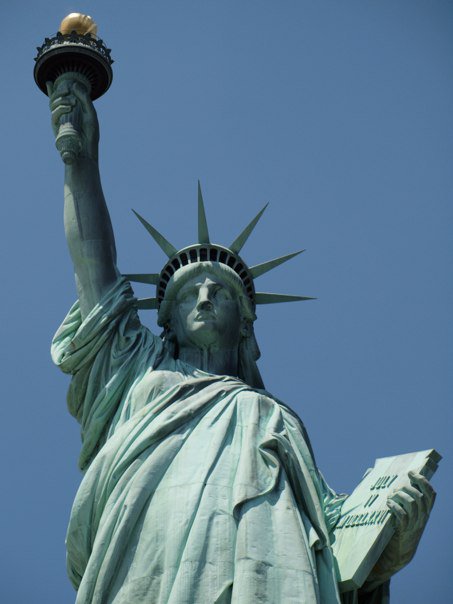
Now my knowledge of the geography of New York was very sketchy so I had to have it all explained to me by my Dad when we got there. For a start, I had no idea that it was a state. Did you??? Once I had that information though, things became a little easier to understand. New York is divided into boroughs - much like London - called Queens, Brooklyn, Manhattan, The Bronx and Staten Island. While in New York, we covered Midtown to Downtown Manhattan, including Ellis Island and Liberty Island, the home of the Statue of Liberty and drove through Brooklyn to get to & from the airport. We went around everywhere by subway and walking which I also liked because, according to Chandler in FRIENDS, no one drives a car in New York so we didn't either! Although our reasons were because it would be healthier & cheaper, not because Chandler said so.

I am going to start on a slightly negative note. I HATE THE SUBWAY. The only good thing is that its air-conditioned. It is so dirty & humid & full of crazy people! Don't get me wrong, I wasn't expecting some ultra modern and clean super system but I was expecting better than what it was. Having experienced the London Tube, I'm used to the dirtiness of travelling underground but the New York heat made being underground unbearable. The most sweating I did the entire week was a subway journey on a train that didnt have air-conditioning. It was awful.

On a more positive note, the sights we were going to see via the subway were pretty damn amazing. Times Square is the most beautiful symbol of consumerism I have ever seen, as your eyes are dazzled by endless flashing advertisements and giant posters of models. I could have lived in Central park easily. It really is an oasis and you can completely forget you are in the middle of a city and go for nature walks among beautiful trees, plants and lakes, go and watch softball games or sunbathe in endless fields (I did all three). Plus you can go and see the FRIENDS fountain! Chinatown is a unique shopping experience as you develop your haggling skills (my personal achievement was getting a bag down from $75 to $25) and a perfect chance to stock up on all the perfumes that are ultra expensive in London (I finally got my Vera Wang Princess - for $15!).

(Image: Times square)

I am a bit ambivalent about the shopping in New York. It is no mistake that there are plllllenty of shopping opportunities, but I unfortunately was disappointed. It isn't as cheap as I was hoping and I didn't find much that I wanted in the major places people go to like Century 21, Macys and (the love of my shopping life) Forever 21. I did however get to stock up on my Abercrombie & Fitch. I refuse on principle to buy it from the shop in London and I was in dire need. I have also developed a love for American Eagle jeans and stocked up on MAC makeup.

The food of New York was...different. Once again I was ambivalent. I absolutely loved most of it but found that eating the equivalent of what would have been two meals in London as one was a bit much on my stomach. I gained half a stone in a week. Plus the lack of places that sold apple juice and meals without bread of any kind disconcerted me. I will say however that I totally prefer food shopping in deli's to supermarkets. As deli's are quite rare in London, is was quite a cool experience to handpick everything you bought.

The people of New York was something I only really experienced through the subway and while in restaurants or shopping. It was really nice being greeted and asked how I was every time I walked into a shop but on the subway, it was very much like London, where everyone just minds their own business and keeps to themselves. I therefore remain undecided and will make no opinion of the New York people until I have met ones who are not in a situation where they are at work and obligated to be kind to me, nor on public transport. I will say that they seem lovely enough though!

The visits to Ellis and Liberty island were really interesting. From 1892 to 1954, Ellis island was the portal for over 12 million immigrants into the US. Liberty Island is the home of the Statue of Liberty. I love the symbolism of freedom behind the two places and the thought of the millions of immigrants that would have passed through Ellis island was very overwhelming. I didn't however, have the major connection with the two places that many people do. Perhaps it is because, to me and my ancestry, Ellis island and the statue of liberty have never really had anything to with us. Despite being a beautiful monument, for me, that was all it was - a monument. Who knows, perhaps I'm harbouring some secret dislike for Lady Liberty because the liberty she gained is from the tyrannical British? I seriously doubt it though.

(Image: the Statue of Liberty)

(Image: the globe crushed by the twin towers)
There was one place, however, that I did have a very strong connection with. Ground Zero. When we went to where the Twin Towers had originally stood, we were met with scaffolding and major building works as the building of the ground zero monument continued but that did nothing to prevent the reality of what happened hitting me. All around the site were more buildings and people and thought that they collapsed into this cramped little space was overwhelming. Everywhere you went in New York you could see signs of the effect of 9/11. On the front of many fire & police stations were plaques for service men that died saving others on that day. In Central park there is a globe that was crushed when the twin towers fell on top of it then rebuilt as a monument and has to be the most thought provoking, emotional & symbolic art work I have ever seen. Even going to times square, which was covered in police officers after the recent terrorist attempt there. What I loved was that despite what happened, the city wasn't coated with fear or suspicion but continued being just as amazing as it had always been, standing up to terrorism by showing its strength and ability for everyone to unite together. That being said, at the time I knew nothing of the protests that were going on against a mosque being built near ground zero. I personally consider them to be the minority that have allowed their fear to control them and turned their fear to hate.

All in all, I really enjoyed New York. It was an interesting place to visit with good food, good people and good sights. But, in all honestly, I didn't live up to the 'greatest' reputation and while I would like to go back to see more of the other boroughs in New York, it hasn't made it onto my list of places I want to live. What do you think? Did I miss something? Is there something I should have done or seen that I didn't? Am I missing the big picture? I don't know, maybe.

In a sentence, my review of New York would be "good, but not great" or perhaps "Chicago's better".

Friday, 20 August 2010

Our New Layout

0 comments
If you have a look at our sidebar, you'll see that we have some handy new changes.

We have listed all the countries which are talked about in different posts so that you can easily find a country that you are interested in, or see what we've written about your own country!

We have listed all the topics we talk about in our posts so you can easily find posts that interest you to read!

We now have our 'Educate, Challenge, Change, Unite' links. Just in case you didn't read the post about what these are, I'll explain again for you here. Those four words sum up our four principles/ideas/aims and can be put together in one explanatory sentence:

By educating one another we can challenge and change our misconceptions & stereotypes, leading to a more united planet.

If you click on one of the links for these words you will find a specific type of post. Educate helps you find all of our educational posts, teaching you about different events or cultures etc around the world. Challenge is where you will find all the posts that discuss and debate current issues including homophobia, islamaphobia, discrimination, stereotypes and more. Change contains posts of personal accounts of peoples preconceptions of things and events that changed them. Unite will have posts that highlight people across the world uniting together for positive causes.

Tuesday, 17 August 2010

Educate. Challenge. Change. Unite

0 comments
You may have spotted the four words that have appeared underneath our name and be wondering, what's that all about? Well, here is an explanation!

Those four words sum up our four principles/ideas/aims and can be put together in one explanatory sentence:

By educating one another we can challenge and change our misconceptions & stereotypes, leading to a more united planet.

Sounds awesome right?

As an added cool idea, on the side of the blog, under Labels, you will see the labels 'Educate', 'Challenge', 'Change' and 'Unite' and if you click on one of those you will find a specific type of post. Educate helps you find all of our educational posts, teaching you about different events or cultures etc around the world. Challenge is where you will find all the posts that discuss and debate current issues including homophobia, islamaphobia, discrimination, stereotypes and more. Change contains posts of personal accounts of peoples preconceptions of things and events that changed them. Unite will have posts that highlight people across the world uniting together for positive causes.

Every day there will be a post from one of these categories for you to enjoy so get reading!

Friday, 14 May 2010

The Apprentice Adviser's Rwandan Mission

0 comments

Nick Hewer is well recognised in the UK as Lord Alan Sugar's adviser in the reality television show The Apprentice but, increasingly important to him, he is also patron for the Hopes & Homes for Children charity.

The charity helps with housing and healthcare for vulnerable children and their families in 10 Eastern European and African countries. "They're essentially ensuring that children grow up in a family environment, but in Rwanda particularly that they're taken out of malnutrition and grow up to be healthy kids - thats the core objective" says Hewer.

In Rwanda, 20% of children die before the age of 5 from malnutrition, malaria and HIV/AIDS, mainly malnutrition. While in Rwanda, Hewer visited one of the 3 'hubs' which treats over 1400 people. These 'hubs' were built to provide shelter, clean water, food and healthcare for children and vulnerable families. "They get a free healthy meal, sex education, inoculations, HIV testing, the weighing and the follow-through with the children so they come back again and again, so they're brought back up to proper weight levels".

Self-help is also part of the project as families are encouraged to keep rabbits as a low-cost source of protein and there are small 'micro' loans to encourage enterprise in the most difficult of circumstances. "I saw one young kid, he was 14, he looked about eight because he was so malnourished, he was tiny. He was sleeping in the corner of a mud hut that is about the size of a potting shed without anything in it. He's now clothed and back in school, but critically, they gave him £20 so he could start a peanut business, roasting them in his little hut and selling them in the market. That little kid can now afford to feed himself, clothe himself and pay his school fees... and suddenly he's a little businessman. Wonderful."

Nick Hewer said "I took away with me the memory of a very inhibited population. They went through the most terrible time, a million people killed in 100 days. I know it was back in 1994 but its still a repressed population. I also got the impression of a country that are really going t0 fight their way through."

This is rewritten from a BBC article (click here) about how high-profile names can help raise awareness of a disease or condition, and bring it under the spotlight. Their video series talks to those in the public eye about their personal reasons for speaking out.

Friday, 7 May 2010

Reginald D Hunter with the American perspective of Britain

0 comments
This video is an interview by British chat show host Jonathan Ross(the British equivalent of someone like Jay Leno or Larry King) with American comedian Reginald D Hunter and a lot of the interview focused around his different experiences in Britain and America (he grew up in Georgia)

Saturday, 10 April 2010

The Diary of a Mail Order Bride

0 comments
In Russia there are 10.5 million more women than men and the competition has led them to have the biggest mail order agency in the world. This documentary looks at what it is like to meet a mail order bride, to marry one and to live with one.

51 year old Dave has been dating Alexandra for 3 years since she contact him online and they are now engaged. Alexandra has just graduated with a degree in civil law and is a qualified nurse. While she has been studying Dave has been sending her £60 a week which is more than the average Russian wage. Dave has only met up with Alexandra 5 times in Russia and she has never come to Britain. But now, Alexandra is giving up her law career and coming to start a new life with Dave in Britain in a small village of 1200 people. After being rejected once and trying for months, Alexandra was granted a fiance visa which allows her to stay in Britain for 6 months to test the water before marrying Dave. Dave's daughter Anna is the same age as Alexandra. Anna is not very happy about her Dad sending Alexandra money. Alexandra cannot speak very much english and Anna says she doesnt understand how you can love someone who cant speak to. Dave had been single for 7 years before meeting Alexandra and spent their whole relationship lobbying for her to come and live with him.On her first day, Alexandra says that she is already certain she wont stay the full 6 months. The house is untidy, dirty, she doesnt like the colours of the walls and a lot needs fixing. She adds however tht "its important to see how Dave lives and learn the traditions here as the cuture seems so different. I'd like to see it." Taken on her first day out in Britain, she says the air smells like poo (the village is near to fields of cows) and while eating lunch in a pub, adds that the British cannot cook. She says she likes the atmosphere in the village and realised that Dave likes alcohol more than the Russians, saying 'this was a big surprise and not a pleasant one'. On Alexandras 3rd day in Britain she is starting to feel very homesick and becomes very angry when Dave goes for a pint when she is in the kicthen making him lunch. Alexandra has decided that she is going back to Russia. Although her visa is for 6 months, after 4 weeks she leaves. Alexandra and Dave haven split up but she is not going to return to the UK. Dave's daughter Anna has decided not to see him since Alexandra came to the UK.When Alexandra leaves, Dave is very upset, saying 'I love her so much, probably more than anyone before'.

Over 800 British men a year apply for visas for their Russian brides. 46 year old David hopes to become one of these men. He has been married twice before and has two sons. After his second divorce, he dated women from Poland, Slovakia and Lithuania until he heard about the Russian marriage websites. On one he met Liuda who is a 22 year old restaurant manager. After being in contact for 7 months, Liuda and David met up for the first time and on their 4th day together, they got engaged. Although they have only met once they planned to marry in 2 months. However Liuda's family disapprove of their engagement and in a week David will travel to Siberia to try and convince Luida's family to let them marry. Luida only broke the news of her engagement 6 weeks ago and her family are in shock. Luida's 16 year old sister says 'they only met for four days and they dont speak the same language, they cant understand each other'. David goes over for lunch, but David doesnt speak a word of Russian and the family do not speak english so they cannot communicate very well. The next day David agrees to sit down with Luida's parents to address their concerns about her going to England and this time they get the help of an interpreter. Afterwards, they give their blessing to the marriage. They will be getting married in Prague because Luida cannot come to the UK without a visa. Luida and Dave have known each other for a year, met twice and seen each other for 8 days.Dave has paid for a £700 wedding package and Luida has paid all of her travel expenses.After the wedding and asked how they feel, Dave says "fine, fine" and "when she speaks more english I think it will be better because we'll be able to understand each other more".

Rod is a 51 year old man from Texas who has come to St. Petersburg Russia on a find love tour. Rod wants to get married but his longest relationship was in his 30's for 4 years. He printed off the profiles of his 20 favourite girls from the website in preparation for his trip. He is on the tour with 15 other men who are all white, aged between 37-62 and all bar two are American. They will be going to specially organised parties where the ratio of men to women is 1 - 10. ONe evening Rod goes on a date with a woman he met on the dating website, Svetlana. After a 3 hour date, Rod went back to his hotel. He spent £240 on Svetlana, including a new mobile phone. Realising she only wanted his money, Rod didnt see her again. At the social, there are 150 women to 15 men, 75% of whom are graduates and 50% of whom are under 30. He meets a particular tall blonde woman called Irena and is instantly smitten but then she gets a better off and turns cold on Rod. 20 minutes later he leaves the social with 2 other girls. At the end of his trip, Rod leaves without having met anyone. He decides to return to St Petersburg in a few months to start his search afresh.

Luicda's visa was approved and she is now living in the UK with David.Rod returned to St. petersburg but remains single. Alexandra and Dave have split up. He has since found out that she had been receiving money from another foreign man.

If you live in the UK, you can watch this documentary here

Friday, 9 April 2010

Battle Scarred

0 comments

150,000 british men and women have been to war serving in Iraq and Afghanistan. Many are young and can be sent to the front line at the beginning of their careers. Many are living with the consequences of serving their country. This documentary loks at the hiden cost of war for the soldiers and their families.

Pte David Forshaw was a paratrooper that served two 6 month tours in Iraq. His mother said that 'he was a born soldier' and loved to be out there. As a teenager Dave was passionate about joining the army. He did not die in Iraq. He died in a car park in South London after he killed himself by inhaling petrol fumes. His family said he had trouble adjusting when he came back and didn't really talk about it. On his second tour he nearly died as his vehicle was hit by a road side bomb when he was in the driver seat.His brother and fellow soldier, Rob Forshaw was also in the vehicle and was injured. Because of his injuries, he was sent to a psychiatrist who helped me through the situation and made him feel better about it all. However Rob says that it was stupid not to do the same for the others, including, Dave, that had been uninjured. After their vehicle had been bombed they were soon sent back to work and 'that would take its toll on anyone because someone has just tried to kill you'.David's landlady said that when he came back, he started doing anotherjob but 'it just wasn't him' and 'he completely lost interest' and when he came back he had to go back to the 'mundane' and had 'no purpose or meaning'.A suicide letter was found in his bedroom and David's severe dyslexia meant it would have taken him months to write. In the letter he requested a st.georges flag be put over his coffin and his mother asked the army if he could be buried in his uniform and if they would send a wreath. They said no to the flag and uniform but sent a wreath. His mother thinks they discarded him because he had taken his own life.

Spr Martin Lindley is 22 and did a tour in Afghanistan in 2007. He was an engineer whose main job was to blow stuff up. Now discharged from the army, he is unemployed and ifnidng life a struggle. he says that when he got back he started dinking a lot more, mainly a litre of vodka a night. He gives the reasons as being that cant sleep at night because he's become paranoid by noises and he uses the alcohol to help him sleep. When he was out in Afghanistan he always had a kife with him and he does now he's back because he doesnt feel safe anymore. He and many of his friends recorded different moments of their tour with their camera phones. Martin has pictures of the 'nice views' and the Afghan people he met that he said were 'really nice and friendly' and then some more disturbing images like dead children, decapitated people and beaten prisoners.One of the first and most frequent operations Martin and his team went out on was to walk the streets and wait for someone to shoot at them and they would then try to spot who shot at them and kill them. They did this twice a day. To help hom readjust after the war, the MOD (Ministry of Defence) sent soldiers, including Martin, to Cyprus and told them to 'get pissed and fight' just to get it out of their system. Then they came back to the UK and play sports and drink for 2 weeks. When he came back from his 6 month tour, he accidentally took back ammunition, which is illegal and lead to him spending 9 months in an army prison and is now discharged. Martin's mother said he had been enjoying life but when he came back from Afghanistan he had really changed.She said that she thought they should all get counselling when they come back because they are trained to kill and then expected to come back and be OK. Although counselling is avaliable if the soldiers ask for it, very few do ask for it because it suggests that they are incapable of handling the stress and could hurt their careers. Martin said that he doesnt see what taking could do and whether it would help. He said he might as well just get on and try to forget it.

Sgt Danny McEneany and CSgt Jason Wilkinson grew up together in Merseyside and both joined the army as teenagers. They were the best men at each others weddings and both served in Iraq together. Danny had recently been released from prison for possessing a firearm. He was in the army for 18 years and served in Northern Ireland and the Gulf but it was when he returned from Southern Iraq in 2005 that he became dangerously paranoid and stole a gun. Like Martin, he couldn't sleep and the slightest noise woke him and made him suspicious. He became paranoid that Muslim fanatics would be coming through his door to kill him. His best friend Jason killed himself. The last time that Danny saw him, Jason told him a secret he had kept for 5 years: he had shot an Iraqi.Danny thought it was the stress of this seret that lead to him killing himself. Jason's marriage had been breaking down and he went to stay with his parents. His mum asked him why and he said it was that he was just full of anger and the breakdown was his fault. His mother said he was in complete turmoil. His mother told him to get help but he refused saying he didn't trust the army. Jason returned to his barracks on the 5th January and hung himself in his room the next day. Like Jason, Danny's marriage broke down when he came back from Iraq. When Danny stole the gun, he was diagnosed with post-traumatic stress disorder but was still given 5 years in prison. His sentence was reduced on appeal but he still spent 2 years in prison. He was given no treatment for his post-traumatic stress and so his new partner Jules has become his carer.Without her, he would most likely have ended up back in prison.she said she thought he would be in much less stress back in Iraq because he is still in combat mode and ready for anything at anytime.Jason was buried on 16th January 2010 with full military honours. Before he died, Jason told his mum more about the incident. He broke down crying and told his mum that he had killed a man. When he was on patrol, he came under attack so he took cover and just aimed and fired and a hit a man. He said he always thinks of this man at christmas, whether he had children. Jason was filled with guilt all of the time.

The makers of the documentary asked the MOD for their response to the issues raised in the documentary. They gave the following statement:

"The MoD takes the mental health of our personne extremley seriously and extensive prevention and treatment measures are in place both on operations and in the UK.

Mental health professionals provide expert assessment and treatment and the new in-theatre mentoring scheme encourages personnel to talk about concerns reducing any stigma associated with seeking help.

The MoD has also worked with the NHS on community mental health pilots across the UK, tailored specifically for Veterans...we are committed to ensuring this important minority gets the treatment they deserve.

Kevan Jones MP
Minister for Veterans"

If you live in the UK, click here to watch this documentary

Saturday, 3 April 2010

Batty Man.

0 comments

Homosexuality has been legal in the uk for 40 years but to be gay in the black community is still looked down on. Gay comedian, Stephen K Amos, looks at why.

He starts by doing a social experiment in Croydon, South London. He takes 8 men, 1 who is gay and 7 who are straight and asks passersby to "spot the gay". Of the 9 men, 5 were black and 3 were white but it was constantly the white men who were chosen, even though all of them were straight. Stephen wonders if this is because being gay is more associated with being white than black. Stephen then took out the 3 white men and left the 5 black. People found it much harder now to choose, with one woman saying "none of them look gay". Stephen then asked people to pinpoint the person they thought was definitely not gay and there was one man in particular that kept being picked as the definietly straight guy, with people saying he looked like a "player" and a "womaniser". He was the only gay guy. When this was revealed, people were always in shock. When Stephen asked whether it proves you can't look gay, one woman said "stereotypical ennit...that views gone out of the window".

One night Stephen is doing stand up in Brixton, South London, to a predominantly black audience that do not know he is gay. For years Stephen hid his sexuality for fear of not being accepted by the black community. Then one event had a profound effect on him. In 2006 one of his friends was killed just for being gay. This inspired him not to hide who he was any longer and he created a one man show where, at the end, he revealed to the audience that he was gay. This gig in Brixton will be the first time he comes out to a mainly black audience. As soon as Stephen says it, the atmosphere completely changed and all fell silent. Suddenly the room felt full of tension and aggression. He went around the room to talk to some of the people. One man said, "I dont do that gay shit", another said "within the black community youre less likely to be accepted by your family if youre coming out and syaing youre gay you might not have a mum or dad anymore", another man said "there are some reasons why gay people dont come out and one of those is the levels of homophobia in our community that dont allow them to be gay", a woman said "when you asked if there were any gay people in the room,there was a hushed silence because no one wantd to say they were gay in brixton because you mght get stabbed outside". Afterwards, Stephen said it was the toughest gig he had done in a long time.

He then went Tooting, where he grew up, to speak to some youths about being gay. One said "they shouldnt have gay people on tv, or out on the road" another "my familys christian so im against gay peope" two girls agreed "if my brother was gay i would disown him" and later said "black gay people are putting the shame on our race they're making us not look black" one girl said "just make a different country for them ennit" one man said "i dont understand how balck people are thinking that they can be gay, i dont think that could actually run" another boy said "give me 2 women and i would be perfectly fine with that" but he was cussed out by the girls around him. This same boy said "if it wasnt for the music and that, i dont think no one here would have a problem with gays because we've been brought up to believe that gays are not right" They started singing an Elephant Man song where the chorus is "step on the chi-chi (gay) man! step on the chi-chi (gay) man!" Another 2 boys had most of what they said bleeped out apart for the words "batty boy". One of these boys said "tellin the truth, in Jamaica thats what they say: batty man must dead".

Stephen decided to go to Kingston, Jamaica to talk to Elephant Man. The strange thing is, Elephant Man said "i got nothing against gay people, do what you want to do, live your life, i cant come and tell you whatever, so do what you wanna do". Stephen wanted to find out what had changed his mind. He finds out that his lyrics had got him in trouble in places like USA so if he wanted to be successful there, he had to change that. Stephen said it was quite an eye opener to see what people will do when there are western dollars involved.

Homosexual acts are illegal on the island of Jamaica and those caught can serve up to 10 years in prison or hard labour.

Stephen met the band the Heavy Steppaz. His producer thought it would be safer if he stayed in the car and the producer would interview them. One of the band said "for a black person to be gay is really wrong...if a friend switched and turned to be a fish (gay)...theres one thing i think for anyone who turns fish...six foot deep." Another said "must be a man and a women...i say its wrong in many ways...to be a batty man you'll end up dead. straight bullet or gunshot or one of those things...if they really turn into a batty boy they cant see me or hail me they cant be my friend they cant even walk near me, much less look at me. thats a straight bullet. we dont see those things in our class or in our league. im telling you straight because right now a man to woman thing we deal with round here...the whole of jamaica, i know that certain men deal with those things...but if he wants to deal with that he'll have to take the backdoor where no one can see him...a straight bullet."

Stephen finally got to meet one young man called Kevin who risked his life to talk in front of the camera. "Being black and gay in Jamaica is very hard...there are times you have to hide because you're afraid to be who you are in public because you might get killed or those that should help you won't love you anymore...it all comes from the Bible and how people were brought up and dancehall, reggae music...i would pray and pray and pray that i would be happy with who i am and that God would still love me for who i am...i havent come out yet officially...if more gay people come out, i will be a lot easier for the younger generation to be acepting of who they are".

Stephen went to one of the jamacian churches to talk to the young christians to see if they thought it was ok to damn gay people using scriptures. The pastor said "as a pastor people come to me and say they have homosexual tendencies and i say bredrin, i dont see it the way you see it, i dont accept it the way you accept it but remember that you have a brother in me and im not gna kill you, im gna defend you. im not gna defend what you stand for, but im gna defend you as my brother, a human being". The people there believe that people can be conditioned to be gay, it is not genetic and they will be there to help people change this condition. Archbishop of Kingtson said "to use christiantiy is a lie... it usually comes from those with a limited understanding of the bible. You can justify anything by taking out a particular part of the bible. It was used to support apartheid. I certainly wouldnt be bashing homosexuals because they homosexuals, that is completely contrary to our christian faith".

Back in England, Stephen decided to come out to a group of young people face to face. their reactions were partly very encouraging with one girl saying "love is love, happiness is happiness and if that means being with another man, then that means being with another man, simple as that". However, not entirely: "I just see it as wrong...thats just my personal belief...i just feel uncomfortable". One boy said "if i was gay i would pray to god to be put down to dead because i cant see myself being gay".

Stephen talks to gay couple Perry and Olisa who have hidden their sexuality since they were teens. Perry said "before i came out, i was a homophobic. when you first realise it, you dont want it. you dont want to be gay". Olisa said "you can look at me and say im masculine. I could take you down the rugby field and break your nose and say yeah im masculine". Perry agreed "just because you sleep with a man, doesn't mean you aren't masculine". Perry said "my black friends dont know im gay. they wont talk to me again". Olisa said "i havent told my mum yet...i would have been on the first plane to Nigeria if i told her when i was young". Later that night, Olisa told his mum. He was really scared but said she was absolutely a brilliant mum. He said now hes got his approval he doesnt care what anyone else thinks.

Watching the programme back, Stephen hears all the arguments for homophobia and says none of them stack up. The religious argument doesn't wash, neither does the one that you arent masculine nor that pushing them out forces them to change. All fear of homophobics does is give homophobia a platform. The only way to dispell the fear is to face up to it, and thats the hardest lesson of all. Stephen said "I thought I was a strong ballsy comic with attitude and a lot of thinsg to say but i never thought i would have to regress into myself like i had to when we were in Jamaica. There were certain situations where i couldnt express myself and i dont owe anybody anything, i was denying myself and meeting Kevin who was younger, lived there and expressed himself so eloquently taught me something. Hey, stand up and be counted".

If you live in the UK, you can click here to watch this documentary

Friday, 26 March 2010

The Russians Are Coming

0 comments

This channel 4 documentary follows Russian international property broker Dina Karpova, who is capitalising on Russia's love for all things English. Dina is an agent to the super-rich in Russia, who want their children to attend the top British schools and so high-tracking them into British high society. Dina says “our clients do want to go to top schools, they do want their kids to be with best British families and be friends with them. There is not one company in Russia that works with top schools or prepares children to go to top schools. The only choice is me.” There are, however, school agents in the Middle East and Asia doing all they can to get their students into schools in the UK. “Competition is fierce, there is no question about it. Now a lot of british schools cap the number of foreign students. You compete with a lot of asian kids who are breeded like racehorses to get into the system".

Dina found this niche in the market when her own son, Ivan, began boarding at Westminster, one of the best public schools in England. Ivan, who speaks with a British accent, boards at Westminster while Dina lives in Moscow. Ivan had a very cosmopolitan upbringing. She wanted to expose him to a lot of culture so he lived in Russia in his early years, then the US and now Britain.

Dina on the other hand had a very different upbringing to Ivan. She wasn’t allowed to speak to foreigners. Her parents were physicists working on top secret nuclear weapons for the government. She had a serious lack of freedom but had a high standard of living. She graduated as an aerospace engineer but the breakdown on communism in the 1990s brought down her privileged life as they were owed a years worth of salary by the government, they had sold everything and had no money. She moved to new York and became a successful businesswoman.

According to Dina “it is quite a trend now in Russia to send your children to England” and “our clients want to match the culture, they don’t want to be seen as Russians”. Charles, an educational consultant that works with Dina, said “traditionally a lot of the great schools have educated a lot of the ruling families so that culture is there and the new Russians are doing their very best to replicate the lifestyles of the tsarists elite and part of that is being educated in the west”. Dina's client in the documentary wants his 11 year old son and stepson to go to a British public school. Dina sends her clients children on a residential course that would introduce them to the English aristocracy and teach them how to blend in. First they learn how to play polo. Dina tells them that if they play polo they will become part of high society. Then they learn how to shoot and one of the teachers messed up the boys room and then instructed them how to clean it and keep it when they are staying at a persons house, like showing them how their bed should be made and what to do after having a bath. They also had intensive academic training to help with the entry exams for the schools. They are also taken with their parents to visit Stowe, one of the top public boarding schools. They are shown around the school by a student who also moved from Russia and soon fall in love with it. The boys and their parents then go on to visit many other schools. The boys receive a conditional offer from one of the public schools and so if they achieve the needed results in January, they will move from Russia to England to attend the school. Charles says “it never ceases to amaze me how brave they are, coming to a new country often speaking only a few words of the language and having to adapt”.

Looking into the future, Dina predicts “that Britain is going to play a huge part in Russian future and I think that is a fantastic thing because these kids will merge the cultures, they’re not going to fight”. Charles adds that “Britain is an extraordinary country in the way that we can integrate so many different people from ethnic backgrounds”.

Image is of Stowe School in Buckinghamshire.
If you live in the UK, you can watch this documentary here

Tuesday, 9 March 2010

Young, Angry and White

0 comments
In July 2009, almost a million voters chose the BNP in the EU elections. As well as the traditional BNP voters explaining this success, a recent survey found one in 20 young people would vote BNP. In this Channel 4 documentary, Peter Beard follows 19-year-old Kieren who is considering joining the BNP but is unsure that the party represents his views. As the Channel 4 summary put it, "t
his fascinating First Cut documentary offers an insight into a young person's attraction to a party whose policies and image continue to cause extreme controversy throughout the country."

Kieren is part of a new generation of far right recruits, "I do want to see an all white Britain. An immediate stop to immigration and repatriation which would follow”.

Walking down the high street, Kieren points out Halal and Carribean food shops saying he doesn't like all of these things being around. He sees them as a threat, culturally changing his town and destroying what his town is about saying that “its just catering for minority groups but it seems like the majority of the high streets are getting taken over by that” and that he doesn't want it "on my doorstep".

Talking about being a nationalist, Kieren says “you have to be a pessimist about the whole society. You gotta be quite angry and depressed and think oh this is horrible everything about this life is just rotten. But then once you have an alternative once you have an answer which manifests itself via the BNP you can only look forward and try and be optimistic”.

The first thought that comes to someone hearing Kieren have such extreme views is that it must come from his family and friends, but that is where you would be wrong. His mum doesn’t want herself or Kieren brothers to be involved in filming the documentary. His mum comes from a background of liberal voters and doesn’t agree with her sons views. Kieren's parents split up when he was one years old and he didn't have a male role model growing up. This has made him want a strong family when he has children and he wants to be the 'breadwinner'. Five years ago, his Dad moved to Wales with his new wife and children and Kieren sees him a few times a year. His dad is a labour voter and says of BNP leader Nick Griffin, “the way he says things makes him look like a complete racist”. He also disagrees with his sons views. After his Dad moved away, life became difficult for Kieren. He and his mum later had to move out of London because of domestic violence and then move again because of another 'woman beater'. He made friends with nationalists from his old London area of Barnet online and then his friendships grew and he was welcomed into their group. He says that he felt like he belonged to something and found it quite comforting.

Kieren doesn't agree with mixed race relationships, hanging a banner in his garden saying "love music, hate race mixing", a twisted pun on the slogan "love music, hate racism". Asked about mixed relationships he said "as a matter of principle I'm against immigration and multiculturalism. Our own women, by fraternising with the other races, they're part of the problem as far as I’m concerned”. Kieren has a girlfriend called Amy. He questioned her heritage, thinking she had an 'oriental look in her face'. She had to ring her sister to confirm that there was no Chinese in her family and he still didn’t believe it. He admitted he wouldn't have dated her if she had Chinese in her family. Kieren thinks that "people should be around their own type of people” and thinks "multiculturalism cannot work, as a concept, or will work...just from looking at social circles, from studying it. I would welcome people to live amongst each other in harmony but I don’t think it can happen”.

He has also made a new group of friends, none of which are nationalist or agree with his views. One of his friends asked Kieren “how do you feel about me losing my virginity to a black girl?” to which he responded “you know how I feel about that and I told you at the time that you hate your own race...Its a form of genocide”. Despite everyone around him disagreeing with his views, Kieren is unashamed to be honest with them, saying things like “its not that I don’t see people as unequal, its that in my life I want people like me around me” and “if they want to call me a racist then fine, I’m a racist, I’ll happily be a racist but I don’t think its racism and I think the word racism needs redefining and we need to have a common sense acknowledgement of what it actually is”. His friends and girlfriend looked very awkward being around while he said these things.

When deciding whether to join the BNP, he watched the infamous episode of Question Time (read about question time here) with BNP leader Nick Griffin. He said “theres never been a question time like this. I enjoy this show normally”. He is extremely disappointed with Nick Griffins performance and unsure whether they still represent his views. This disappointment was made stronger by the news that the BNP could be extending their membership to allow non-whites to join their party. Kieren doesn’t join the BNP. Instead he attends the annual National Front remembrance march. The National Front are a far-right party that have stronger views than the BNP and are arguably more racist and elitist.

The filmer, Peter Beard, talks to a militant group who also grew disillusioned with the BNP. They only agreed to talk if they could be in disguise. The man speaking for the group said “we would like to see England returned to the hands of the people who have the blood right to this country... their blood is in this soil... we have seen the filth flooding through our streets, we have seen a consumerist nation overtake a moral nation”.

Kieren admits that there can be problems with not wanting to integrate with other races. “A lot of nationalists might suffer from social problems I suppose. You don’t really want to indulge in a social life with people who don’t see everything along the route lines as you. I don’t not want to have a life. Nationalisms brilliant and I put all of my thought into it but at the same time I’m 19 and I want to live a normal life”. Sometimes his nationalist views provide a worry to Kieren: “I want to do well and I feel like I’ve turned it around from not being in school to being in education. I want to enjoy university and have a great time and I want to enjoy a successful career. It shouldn’t be considered wrong for me to say how I feel no matter how un socially acceptable it is I’m not doing it in an aggressive manner. I do worry that my honesty in that regard could hold me back."

If you live in the UK, you can watch this documentary here:
Young, Angry and White

Monday, 1 March 2010

Osama Bin Everywhere: The Many Faces of Everywhere

2 comments
Osama the Schoolboy, 5, from Casablanca
(Image from Osamaloves.com: Osama the schoolboy,5, from Morroco who loves his chick)

There are 1.4 billion Muslims in the world, but many people are only able to name one: Osama Bin laden. Creator of this documentary, British born Pakistani Muslim Farrah, set out to prove that not all muslims are terrorists with the help of her fellow muslim friend Masood. They travelled around the world for 50 days meeting people of different cultures with different problems and different passions but they all have one thing in common: they are all called Osama.

While the day that changed the USA was 9/11, the UK changed after the 7/7 bombings in 2005, where bombs exploded on 3 underground trains and a double decker bus. It was a day that rocked the UK and, in particular, London. Before we had been watching terror attacks on the news, now we were having attacks on us. It was one of the moments where you can remember where you were. Robyn, 18, was in the waiting room of the orthodontist and on the radio they were saying something has happened on the trains although it isn't clear yet they thought there had been some kind of major power cut and later found out the double decker bus had exploded outside her fathers office in Tavistock Square, London. Farrah took the bombings as a personal attack on her home and when she heard that the people who did it were the same ethnicity, religion and linguistic background as her, it was "a bitter pill to swallow". The suicide bombers were British Muslim men, three of Pakistani descent and one of Jamaican. Now she feels angry that extremists have stolen the limelight and has had enough of being pidgeon-holed into being extremist terrorists.

Her idea was to go around the world, meeting Osamas, finding out what they love and proving to the world that not all Muslims are terrorists. She began in the UK with Osama 37 from Worchester, UK who loves hip hop and Osama, 17, an A Level student from Warwick that loves innovative web design. She then posted these onto www.osamaloves.com where other people with the name Osama can post what they love.

The first country the pair travelled to was Nigeria, West Africa where 50% of the population are Muslim. They first try to meet an Imam called Osama but on the way, he becomes suspicious of their motives and decides to pull out. Slightly frustrated, they hit a local market and try to find someone and they meet a tailor called Osama who says that he thinks they are doing this programme to “enlighten America and perhaps the whole world the name Osama is just a name and doesn’t belong to a terrorist”. This Osama is 23 and loves footballer Ronaldo. They find another working right next door that loves tea. Word spreads and the osamas just keep coming. They find one that loves his chickens, a blacksmith that loves football team Man United, a goat herder that loves football team Arsenal, a tanner that loves football player Wayne Rooney and one that loves Nigeria. It soon becomes clear that the country is football mad, particularly for British football teams. She also meets a musician called Osama "bin Music", who made it his stage name after the famous bin laden. His favourite music is dancehall and he loves Beenieman. In the UK, Farrah says that many believe music and Islam don’t mix, but in Nigeria Osama says that there is no problem: "Islam allows singing, songs were sung in front of the prophet but he laid down rules that a woman is not supposed to reveal her body, a man is not to touch a woman while he is singing and the song should convey a message that will benefit the listener not something that would corrupt their minds or lead them astray". Going on from this, Farrah then goes to meet an Osama who was a judge responsible for shutting down the Nigerian film industry under Sharia law. He said that “the ban was correct because these kinds of films don’t teach anything. Drama should teach people something. Teach them what to do and what not to do. These thinsg are just a copy of what goes on in Europe. Theyre just dancing and singing and romance... These kinds of pleasures teach bad things... Those from the west taught us how to commit burglary and to break into a womans room and rape her. Thats how we learnt those things. ” Farrah says his judgements about western culture seem “a little farfetched” but back home in the UK many people share his views, with parents thinking their children are becoming “too westernised” and losing their traditional values. From Nigeria, they met 19 total Osamas.

They next went to Cairo, capital of Egypt. The country has a 75 million population and 90% of them are muslim. Osama is an Arabic name which, loosely translated, means young lion, and in these parts the name is as common as John or James is in the west. It is so common that to find an Osama, all they have to do is walk in the street and yell the name. Doing so, the first Osama they meet is 23, works downtown and loves his fiancĂ©e. Next they meet an Osama who is an air traffic controller that loves peace. He went to America before 9/11 and then after he changed his name to Sam. When people in the west hear his name is Osama and that he is an air traffic controller, they do not trust him because of his name. They meet more Osama’s that love the internet, their mum, Egypt, foreigners, laughing, their neighbours, investing, a girl (its a secret), Kebab, black Sabbath and a seven year old that loves bananas. Talking about her time in Egypt, Farrah says “I’ve not meant any extremists... not a single person who said it was right to blow up the twin twoers or bomb London". While there on a Saturday night, the whole of Cairo came to a halt, as a football match is on and the country is also football mad. The star player of one of the football teams is called Osama. Farrah meets him and asks him about being a role model and he says “its definitely a responsibility. Not only when im playing but everything outside football as well. The way I am wuith my friends when im on tv and when im playing. Im not doing this for myself its between me and God. God will reward me for that – this is what Islam is about.” He recorded a tape of the Qu’uran which was very successful and they gave the income to poor people. He loves scoring goals. One of Farrah's observations is was that in the west, it would be rare to find a football player that you could go to for religious guidance. The next Osama they met was Osama Mounir, who famously tackles the taboo subjects of sex and love on the radio. He loves love. When he first began his radio show, he couldn’t believe how many people were listening and became an overnight celebrity. He even has listeners calling from America and Europe. His voice is now the most recognisable in the Arab world, with deep gravly tones similar to Barry White. This Osama is actually a Christian. When asked what he would do if a girl called saying she was Muslim and wanted to have a relationship with a Christian, he said he would tell her not to do it because it would cause so many problems. In their community they have to have the blessing of the family and no one would bless the marriage. Farrah admitted she was disappointed by this advice after all the pressure she feels to marry a nice Muslim boy but would prefer to just let love choose. In Egypt they met 57 Osamas including ones that love the sahara, their girlfriend and horses.

The next country that Farrah and Masood were meant to go to was Pakistan, but they haven't yet given them filming permission so they cannot go there. Farrah said she is "actually embarrassed of the obstacles we've met... we're trying to do a good thing".

Instead, they next go to Indonesia in the far east. It is home to more muslims than anywhere else in the world: 200 million. The first Osama they meet is a little boy who was originally born in Leeds, England on the 11th September 2001: the day of the terrorist attacks. He loves riding his bicycle. Talking to his father, they are told that he was named Osama before any of this happened. He told the midwife he would name him Osama and she said “oh very good, that’s nice” but when he was going home, "she never smiled again". He was born hours before the first plane struck the towers. Osama's father says that he doesn't think Osama will have problems in the future: “it depends on Allah”. They next meet an Osama that owns over 400 goats and sells the milk all over the city. He loves martial arts. She also meets Osamas that love manga, an engineer that loves his days off and one that loves intelligent women. They meet 75 Osamas in total.

Next they go to Toronto, Canada. It has the highest number of Muslims of any north American city. They have had a lot of press interest for the documentary, with them getting onto national news almost as soon as they arrive. Very soon after being on the news, the Osamas get in touch. They first meet one that moved from Sudan to Canada. Osama says that Canada is very accepting and he thought that "there were would be more problems than there were". He loves acceptance. They also meet an Osama originally from Pakistan and he too feels very welcome in the country but for his parents it was difficult as every step he took towards the Canadian culture, they saw as a negative step: his hair style, his music, his clothes. His parents have a fear of him drifting from their culture to the western. He loves sandy beaches. Looking back at the website Osama loves, Farrah and Masood see there was an Osama, a writer from USA that loves global dialogue and say that he is the perfect example.

Farrah talks about the importance of getting permission to go to Pakistan because it is being associated with the training and recruiting of terrorists and “its name is becoming mud, and that hurts me”. They do manage to get the filming to go to Pakistan. They arrive on the eve of independance day, the biggest night of the year. They meet an Osama who was a newsreader from London at the time of the bombings and was on the way to work at the time and was evacuated from the station. When he found out British Pakistanis were responsible he didn’t want to believe it but also thought “oh crap, now its us who are going to suffer” because everybody is naturally going to think that everyone coming from Pakistan is coming with the notion of blowing London up. He says that “terrorism and Islam are 2 things completely apart”. They go to meet Masoods family in the town of Lahore and his cousin called Osama who was born 2 months after 9/11. Masood is worried his uncle named his cousin after Osama bin laden. When they ask him why he chose that name he says that “there was a guy at his school called Osama who was very intelligent” and says that he didn’t name his son after Osama bin Laden. He says “nowadays everywhere in Pakistan there are bombings. Everyone is frightened even in Lahore we are frightened. I work in the areas that bombs are going off. When my family hear of a bombing they are so worried... no one can stand their family being harmed”. Back at the hotel they are met with devasting news that a suicide bomb has rocked Lahore. Farrah says “it sickens me... the timing of it... the eve of independence day, the one day of the year the ordinary Pakistani can celebrate and be joyful and they do this at midnight”. In the first three months of 2008 over 600 civilians died in blasts around Pakistan. Masoods friend Jerad talks about how they are becoming an everyday occurrence “we are the ones who are paying in this world... it hurts us a lot when people are saying that we are terrorists. This is so painful, you have to fight tears when you hear it. We are victims not terrorists.” After talking to Jerad, Farrah says “there is no mistake who is taking the brunt of this war on terror”. Despite the earlier bombing, later that night everyone is out in the street celebrating independence day and Farrah says she is “so proud to be Punjabi and have a heritage in this region. The resilience is astonishing”. It reminds her of how Londoners picked themselves up after 7/7 and refused to let the bombers have their way.

When Farrah and Masood went back home, they invited Osamas from all over the UK to help them celebrate. They had ones that love reading, love, playing chess, football, a 57 year old entrepreneur that loves meatballs and a 13 year old that loves his name. Farrah says that she set out to prove that not all Muslims are the same but she wasn’t expecting just how different they all are: Nigerian Muslims are different from Egyptian Muslims and both are different from British Muslims. Nevertheless there was one thing that this journey had made Farrah sure of: “How can anyone look at those faces and think that those people are associated with terrorists and violence?”

If you live in the UK you can watch this documentary at:

http://www.channel4.com/programmes/osama-bin-everywhere/4od

People all over the world can visit:

www.osamaloves.com

What do you think of peoples prejudice towards Muslims? Are you Muslim? Leave a comment and let us know!

Photobucket