
We just thought you should see this! It is an excellent poem, it really makes you think. What do you think?
Showing posts with label USA. Show all posts
Showing posts with label USA. Show all posts
Thursday, 28 October 2010
Thursday, 14 October 2010
London Mayor, Boris Johnson, Cuts Funds to Black History Month
Labels:
Celebrations,
challenge,
culture,
ethnicity,
Ireland,
politics,
Religion,
UK,
USA
3
comments

In February this year I was disgusted to read that Boris Johnson, the current Mayor of London, had slashed funding for big multi-cultural events while putting £100,000 into a new venture to celebrate America. Here is a portion from the Guardian report:
Figures seen by the Guardian show that the London mayor cut funding for Black History Month, a series of events staged in October to celebrate black culture in the capital, from £132,000 to £10,000, though city hall insists the previous figure was £76,000. Africa Day’s £100,000 grant from the London Development Agency was axed completely and a decision to cut funding for the St Patrick’s Day celebration was roundly criticised last year. Funding for Jewish events was halved to £50,000.
Johnson was accused of “subsidising wealthy Americans” after the Guardian reported earlier this year that the development agency, the mayor’s economic arm, had allocated £75,000 to USA Day. It emerged yesterday that the mayor has agreed to top this up with a further £25,000 from the Greater London Authority (GLA), bringing the total to £100,000.
This information clearly demonstrates where Boris Johnson's loyalties lie and, to be honest, do not help the perception of him being a racist, elitist, out-of-touch, suck-up Conservative.
The 2007 estimates for the number of Black people in London (including those with a mixed black heritage) were 12.1% and 12% were Irish. A study in 2002 found there were 195,000 Jewish people living in London, the 13th highest city in the world.
As for the number of American people living in London? The 2001 census recorded 44,622. Jamaica alone had 80,319 while Ireland had 157,285.
So now we have a few facts, lets step back and look at this decision:
The Mayor of London decides to cut funding to celebrate Black, Irish and Jewish events, with some funding being cut altogether, despite the fact that these three cultural groups make up a substantial portion of the population of London, a city that PRIDES itself on its cultural diversity and loves to celebrate it. He then grants £100,000 to a culture which in 2001 made up 0.85% OF THE LONDON POPULATION.
The Guardian says: Johnson has previously defended the move as part of a drive to attract more American tourists to the capital
So is Mr Johnson suggesting that Americans won't go anywhere that doesn't big up their country? Correct me if I'm wrong but doesn't going holiday suggest you want to explore a new and different culture rather than celebrate your own? How many Americans sit at home and think 'oh I wish I could celebrate America... I know, I'LL GO TO THE UK! THEY HAVE USA DAY!'?
Responding to the outrage of this decision, a spokesman for the mayor said:
"Events must have local and community support if they are to add value and make a proper contribution to community cohesion in London, and as has been seen with the celebrations for St Patrick's Day and a new Jewish cultural festival that is coming up, it is possible for communities themselves to create greatly enhanced events, but with reduced GLA funding. The GLA does not own Black History Month or Africa Day, but we would hope community groups would be able to develop programmes that mark these in a similar way."
This is possibly the angriest a Tory politician has ever made me - OH WAIT STRIKE THAT, NOW THEY'RE INCREASING UNIVERSITY TUITION FEES, THE ELITIST BASTARDS! - and I cannot wait for the Mayoral Election when I can do my bit in helping kick Boris Johnson the hell out.
Robyn
To read the full article, click here


Monday, 27 September 2010
Tourist Stereotypes And The Dangers
 The fat Southern American couple that can't pronounce the names of the sights. The Japanese tourist group avidly taking photos of everything. The hippy travelling students that leave mess and noise in their wake. Tourist stereotypes are extremely common, often being endorsed in films and advertisements. But there is a darker side to these stereotypes that many of us don't realise.
Let's take a closer look at the American tourist stereotype, for example. From having a look on Google, it seems the common stereotype is for American tourists to be loud, obnoxious, ignorant, unappreciative and with a sense of superiority. Oh, and of course they are all overweight. There are web pages dedicated to helping American's keep themselves from appearing like tourists with advice like "be quiet!" "don't compare everything to the USA" and "Leave your baseball hats, backpack, fanny pack and water bottles at home".
This is the problem with stereotypes; they all tend to be negative. As stereotypes often become our common associations to a particular group, we therefore develop negative thoughts about the group as a whole. When looking at stereotypes as a whole, this is one of the biggest arguments I can think of against them but in particular to tourists, when the locals have these associations, one emotion tends to crop up wherever the tourists do: irritation. We become irritated that these people are in our country, often their pure appearance or the fact that they are clearly foreign is enough to piss us off. This in turn leads to tourists thinking that the population of that country are rude and horrible, leading to a stereotype of that population and the vicious cycle continues.
The example that springs to mind here is France and the English. I have heard many English people complain that the French are extremely rude to English people who visit France. On the other side however, the French find it extremely rude the way the English behave while in France, with stereotypes of treating the French who can't speak English as if they are stupid with big hand gestures and speaking very slowly still in English (as if that will somehow help the French understand). Ultimately the whole problem stems from a misunderstanding of each other that has been exaggerated and cemented through a stereotype.
In future, even if a tourist does appear to fit a stereotype, don't let this cycle continue. Walk up to that overweight American in the brightly coloured shirt and just let them know that in your country the handshake is not used or most people don't speak English or the name of that tourist attraction is pronounced this way not that. By politely educating each other and generally just being kind to one another perhaps we can exchange these negative stereotypes for positive ones. Its worth a shot, right?
Tuesday, 14 September 2010
Sep. 11: Pre-Post
Labels:
educate,
unite,
USA
0
comments
This is the exact site of the World Trade Center that were flown into on Sep. 11. On Sep. 11, 2010 I took a trip to New York to see the crowd and experience the atmosphere. I must tell you that it was really interesting.
Right now, I am looking for some insight from our readers. I would like to know what do these picture say to you?


Image: 1
* The site of the World Trade Center.
Image: 2
*Two of the multiple people debating
Image: 3
* Take a close look at this picture, these individuals created a HUGE crowd amongst them.
Image: 4
* The Anti-Islamic Center Rally:
There were tons of people here. The crowd became really angry with those who support the Islamic center.
Monday, 13 September 2010
The World's Got Talent
Labels:
Australia,
Brazil,
Bulgaria,
China,
Croatia,
educate,
India,
Indonesia,
Lithuania,
New Zealand,
Norway,
Serbia,
South Africa,
the Netherlands,
UK,
Ukraine,
USA,
video
0
comments
In 2007 the TV reality show Britain's Got Talent, created by Simon Cowell, was aired for the first time. Anyone across Britain had a chance to audition their talent, whatever it may be, to the three judges Simon Cowell, Amanda Holden and Piers Morgan. At any time during the audition, the judges may show disapproval to the act by pressing a buzzer which lights a large red X on the stage. If all the judges press their buzzers, the act must end immediately. To advance to the second round, auditionees must get at least two yes votes or they would be sent home. After the audition process, out of 200 successful acts, the judges had to choose 40 to go to the live semi-finals. Eventually the competition is whittled down to one winner and the prize was a chance to perform their talent at the Royal Variety performance that year.
America's Got Talent
Australia's Got Talent
India's Got Talent
Indonesia's Got Talent
South Africa'a Got Talent
Lietuvos Talentai (Lithuania)
Supertalent (Croatia)
Ukraine's Got Talent
Ja imam talenat! (Serbia)
Bulgaria's Got Talent
Holland's Got Talent (The Netherlands)
Qual é o Seu Talento? (Brazil)
New Zealand's Got Talent
China's Got Talent
Norske Talenter (Norway)
There are now versions of the show all around the world so below are videos from as many of the different ones that we could find!
Britain's Got Talent
America's Got Talent
Australia's Got Talent
India's Got Talent
Indonesia's Got Talent
South Africa'a Got Talent
Lietuvos Talentai (Lithuania)
Supertalent (Croatia)
Ukraine's Got Talent
Ja imam talenat! (Serbia)
Bulgaria's Got Talent
Holland's Got Talent (The Netherlands)
Qual é o Seu Talento? (Brazil)
New Zealand's Got Talent
China's Got Talent
Norske Talenter (Norway)
Saturday, 11 September 2010
Today's Celebrations 11th September
Labels:
Celebrations,
Micronesia,
Pakistan,
Rastafarian,
Religion,
Spain,
USA
0
comments
Today is...

Catalan National Day in Spain
Liberation Day (Kosrae, Pohnpei) in Micronesia
Quaid-e-Azam / Jinnah's Death Anniversary in Pakistan
Patriot Day in the United States of America
New Year's Day in the Rastafarian religion
Wednesday, 8 September 2010
The Longest Place Names In The World!
Labels:
Australia,
Canada,
country comparisons,
educate,
Finland,
India,
Ireland,
Mexico,
New Zealand,
South Africa,
Thailand,
the Netherlands,
UK,
USA,
Wales
0
comments
Llanfairpwllgwyngyllgogerychwyrndrobwyllllantysiliogogogoch - North Wales


This town has become famous because of its long name. It has the longest train station name in the UK. The name translates as "St Mary's Church in the hollow of the white hazel near a rapid whirlpool and the Church of St Tysilio of the red cave". To have a go at trying to say the name, click here!
Taumatawhakatangihangakoauauotamateapokaiwhenuakitanatahu - New Zealand

Taumata whakatangihanga koauau o tamatea turi pukakapiki maunga horo nuku pokai whenua kitanatahu is the Māori name for a hill, 305 metres (1,001 ft) high in New Zealand.It has gained a measure of fame as it is the longest place-name found in any English-speaking country.
The name on the sign that marks the hill is "Taumata whakatangihanga koauau o tamatea turi pukakapiki maunga horo nuku pokai whenua kitanatahu", which translates roughly as The summit where Tamatea, the man with the big knees, the climber of mountains, the land-swallower who travelled about, played his nose flute to his loved one. At 85 letters, it has been listed in the Guinness World Records as one of the longest place names in the world.
Other forms of the name are longer still: "Taumata whakatangihanga koauau o tamatea ure haea turi pukaka piki maunga horo nuku pokai whenua ki tana tahu" has 92 letters. An even longer version, Taumata-whakatangihanga-koauau-o-Tamatea-haumai-tawhiti-ure-haea-turi-pukaka-piki-maunga-horo-nuku-pokai-whenua-ki-tana-tahu, has 105 letters and means The hill of the flute playing by Tamatea — who was blown hither from afar, had a slit penis, grazed his knees climbing mountains, fell on the earth, and encircled the land — to his beloved.
To have a try at saying this name, click here!
Krung Thep Mahanakhon Amon Rattanakosin Mahinthara Yuthaya Mahadilok Phop Noppharat Ratchathani Burirom Udomratchaniwet Mahasathan Amon Piman Awatan Sathit Sakkathattiya Witsanukam Prasit - Thailand
This is the ceremonial name of Bangkok, Thailand, in Thai; it has the Guinness World record for longest place name in the world. The translation is:
krungthep mahanakhon
The land of angels, the great city of
amorn rattanakosin
immortality, various of devine gems,
mahintara yudthaya mahadilok pohp
the great angelic land unconquerable,
noparat rajathanee bureerom
land of nine noble gems, the royal city, the pleasant capital,
udomrajniwes mahasatarn
place of the grand royal palace,
amorn pimarn avaltarnsatit
forever land of angels and reincarnated spirits,
sakatattiya visanukram prasit
predestined and created by the highest devas
Chargoggagoggmanchauggagoggchaubunagungamaugg - USA

This is the longest place name in the United States at 45 letters and is a lake in Webster, Massachusetts. It means "Fishing Place at the Boundaries — Neutral Meeting Grounds" and is sometimes facetiously translated as "you fish your side of the water, I fish my side of the water, nobody fishes the middle". The lake is also known as Lake Webster.
Mamungkukumpurangkuntjunya Hill - Australia
The longest official geographical name in Australia is Mamungkukumpurangkuntjunya Hill. It has 26 letters and is a Pitjantjatjara word meaning "where the Devil urinates".
Muckanaghederdauhaulia - Ireland
In Ireland, the longest English placename at 22 letters is Muckanaghederdauhaulia (from the Irish language, Muiceanach Idir Dhá Sháile, meaning "pig-marsh between two saltwater inlets") in County Galway.
Tweebuffelsmeteenskootmorsdoodgeskietfontein - South Africa
Tweebuffelsmeteenskootmorsdoodgeskietfontein is the name of a farm in South Africa and is Afrikaans for "The spring (lit. Fountain) where two buffaloes were cleanly killed with a single shot", which follows a common format for place names in South Africa. It is uncertain as to whether Tweebuffelsmeteenskootmorsdoodgeskietfontein is the name of a farm, or a small town in South Africa, as various sources state either of these two as being correct.
Äteritsiputeritsipuolilautatsijänkä - Finland
Äteritsiputeritsipuolilautatsijänkä is a bog region in Savukoski, Lapland in Finland. The name is 35 letters long and is the longest place name in Finland.
Pekwachnamaykoskwaskwaypinwanik - Canada
This is a lake in Manitoba and Nunavut, in the Inuktitut language and at 31 letters is the longest official one-word placename in Canada.
Venkatanarasimharajuvaripeta - India
Venkatanarasimharajuvaripeta is a village in Andhra Pradesh, India. It is in the Telugu language and is the longest place name in India. It is also a railway station in Andhra Pradesh on the border with Tamil Nadu, India with the distinction of having the longest name among all stations on the Indian Railway system.
Gasselterboerveenschemond - Netherlands

Gasselterboerveenschemond is a hamlet in the Dutch province of Drenthe.It is the largest town name of The Netherlands that is written as one word. With 25 characters it is just one character larger than Gasselternijveenschemond, which lies a few kilometres from Gasselterboerveenschemond. To try to say the name, click here!
Parangaricutirimicuaro - Mexico
Nuevo San Juan Parangaricutiro, in the Mexican state of Michoacán, is a small village near the Parícutin volcano. The city is called "Nuevo" (Spanish for "New") because the original San Juan Parangaricutiro was destroyed during the formation of the Parícutin volcano in 1943.San Juan Parangaricutiro is also famously known as Parangaricutirimícuaro, the longest place name word in Mexico. Some believe that “Parangaricutirimícuaro” is an urban legend and does not exist. It is the object of the folklore of many fictitious fables. The word itself is a tongue-twister and it is also used in longer tongue-twisters that include nonsense words similar to Parangaricutirimícuaro.To try to say the name click here!
Information from:
Thursday, 2 September 2010
Neither Black nor White - The Confusion of Being Mixed Race
Labels:
Africa,
Canada,
Caribbean,
challenge,
change,
culture,
discrimination,
ethnicity,
Global,
Great Figures,
India,
society,
South America,
UK,
USA
0
comments
 In today's world, our race or ethnicity has an enormous effect on our personal identity. Races have histories, celebrations, countries of origin, cuisines, music styles and more. Mixed race, or biracial people have ancestries which come from different races. Technically, we are all multiracial as people boast of being "1/3 Italian, 1/5 French with a Grandma from Scotland" but the term mixed race/biracial refers to those with parents from two different races.
 As racism declines and globalism increases, it is inevitable that the number of mixed race people around the world continues to grow. It is still, however, uncommon. In 2006, biracial people made up 2% of the United States population, 1.5% of the Canadian population. In 2005 in the UK, 3.4% of newborn babies were mixed race and by 2020 the mixed race population is expected to be Britain's largest ethnic minority group with the highest growth rate. There is an estimated population of Anglo-Indians is 600,000, with the majority living in Britain and India. 2.4% of the 2007 Singapore population were mixed race. Although the most common mixed ethnicity is some form of black and white, the combinations are endless as the different kinds of races are endless.
Even though being from two different races means you have two different cultures to enjoy, the difficulty comes from the fact that technically, you are neither of those two races either. In a sense, mixed race people are born with a completely blank slate and they can create their own identities. Take me, Robyn, for example. My mother is black Caribbean and my father is white British. While my skin is brown, I am not black but neither am I white. I am both and yet neither and this fact is dealt with differently by each mixed race individual.
I have never connected myself with either the white or black cultures and my race has never even really been an important factor to me. I've always found that its other people who are more concerned about my race. 50% of the time people ask me "where are you from?" and, although I always know what they mean, I like to reply "Harrow" or "London" so they then ask "no, I mean like what country originally?" Then I explain my two different parents. The other 50% like to take a guess and BOY have there been some guesses. I've been mistaken for Indian, Greek, Middle Eastern, Native American, all of the Caribbean islands and just about all of the countries in South America. The only trouble I've ever found with being mixed race is when I am unable to fit in because I'm not a certain race. All over the world there are people who only hang out with and date those of their own race. One such experience when I was a teenager was when my Indian best friend ditched me to join a group of Indian girls just like her. I couldn't appreciate or join in the Indian culture and it must have gotten tiresome for her. Losing a friend because I was mixed race was difficult to accept but for every Ying there is a Yang: there are many men in this world who specifically find mixed race girls HOT. Don't know what it is, but they do! And I have never again found any trouble with my friends and have friends of all different races from all over the world. I also only take my race seriously when I get called Half-caste, the word I hate most in the whole world. I am NOT half of anything. Because mixed race people are so uncommon and the term half-caste has never been widely recognised as a racist term, people often use it in a completely neutral manner, not realising how offensive it can be. Think of it this way: the term "coloured" for black people isn't widely recognised as racist as such, but if a black person got called that, odds are they would be offended and think "I'm not a frigging paint by numbers."
There are also a high number of mixed race celebrities in this world and fame doesn't prevent them having their own mixed race experiences.
Halle Belle recently told Lesley O’Toole how her White Liverpudlian mother Judith met her Black GI father Jerome, when he was stationed in England. She moved to America to marry him and they settled in Cleveland, Ohio. Initially, Berry’s parents lived in a black neighbourhood until Halle was four. However around this time they separated and Halle’s mother moved her and her sister Heidi to a white neighbourhood. 'When we lived in the black neighbourhood, we weren’t liked because my mother was white. In the white neighbourhood, they didn’t like me because I was black. That was the beginning of my trying to be what I thought people wanted to be.'
In this excerpt from her autobiography, Catch A Fire, Melanie Brown (Scary Spice from the Spice Girls) tells the world her thoughts on mixed-race. 'I was lucky that my parents were so cool about race when I was growing up. They respected each other's cultures and mixed them and were happy about it, which was rare. They taught me always to respect both Black and White people. I've since noticed that Mixed-Race kids can get really confused if there parents sway one way or the other and are prejudiced against White or Black, because they become alienated from one side or the other. It's difficult because you've got your Black communities and you've got your White communities. There are Black churches, White churches, Jewish, Buddhist, Muslim and other places of worship, but you don't get anything officially for Mixed-Race people. I'm not saying that being Mixed-Race is a defined culture and has a history - well, it has got a history but it's been taboo for a long time, because society has always been so divided. For centuries, Mixed-Race children were mainly associated with being products of rape, the result of forced encounters between masters and slaves on plantations. They were ignored, their existence swept under the carpet and they were part of a forgotten history. Things have changed now. We're starting to mix more and you get people who are quarter this, a half that and a quarter something else, which is great. The only problem is that there are a lot of kids growing up who don't feel they belong anywhere. Their identity isn't black or white. I had problems knowing where I fitted in sometimes. I had Black friends and I also had White friends and some of my Black friends would be completely on the Black side dissing the Whites, while some of my White friends were completely on the White side and didn't really know anything about the history of Black culture. They had no idea about all the suffering that had gone on. I was different to the other Mixed-Race kids at school because I never chose one side over the other. I got on with everyone and as a result I was called 'Bounty' - Black on the outside, White on the inside. I remember thinking, Why are they calling me that? My parents had Black friends and White friends and I spent time with my mum's family and my dad's family, so my life was properly mixed, even down to the music I heard at home - from Aswad to the Eurythmics’
John Conteh was born in Toxteth, Liverpool, to a Sierra Leone father and an Anglo-Irish mother. Frequently in trouble as a teenager, his father steered him towards boxing. On March 13th 1973, at the age of just 21, he won the European light heavy-weight title. He went on to win a string of titles including the WBC Light heavyweight title. John said in his autobiography, ‘My first realisation that I was different from my white mates came when I was making sand castles from some builders materials in the road, that’s how young I was.A drunk loomed over me and began kicking my castles over and called me some frightening names. The one that struck the most fearful chord in my child’s brain was half caste.I remember running indoors to my mother and demanding some kind of explanation. When she told the old man about it that night, he roared like a lion, shouting: ‘My children are not half of anything. They are full human beings.’
For footballer Curtis Davies it is important that people acknolwedge all of his racial identity.'I'm as much white as I am black,' he says. 'People have got to acknowledge that. My mum is white and I don't want people to discount that.' Curtis has an older half-brother who is white. 'Every time we went to football people couldn't believe we were brothers,' he says. 'They couldn't take that I could be related to a white person.' For Curtis Davies having a fluid identity can also raise difficult questions. 'If I'm walking down the street with black mates, it's cold and we've got our hoodies up, we are likely to get name-checked by the police. I've been with my white mates, same area, same hoodies and it's never happened. The police don't even look or slow down. I guess that's another aspect about the split in my race,' he says. Curtis is aghast at the idea of having to choose. 'Choosing which room to go into?' he says. 'That's like choosing who to save from a burning building, your mum or your dad.'
Manchester United's Welsh International winger Ryan Giggs gave a remarkably frank interview in the French weekly L'Eqipe Magazine, when he publicly acknowledged his black heritage. 'Most people do not know that my origins are African-Welsh, in fact only the people who are close to me and who count for me know my whole story. Looking at me from the outside, it is not very obvious, I know but half my family is black and I feel close to their culture and their colour. I am proud of my black roots and of the black blood that runs in my veins. I do not wish to hide my origins, nor do I seek to make it a subject of conversation. I am what I am.'
Growing up surrounded by white faces in Welwyn Garden City in Hertfordshire, English footballer David James was the only non-white child at his junior school. 'I was called a coon and a black bastard,' he says. 'I lived with my white mum so I couldn't go back to an ethnic home and relate the experience. At school I was asked if I was adopted. I got confused and I'd go home and ask my mum if I was divorced.' David believes that there was a direct correlation between bullying because of his mixed-race background and his low self-esteem. 'Trying to break records in goal was all about proving that I was valuable.' David also had a problem with the term half caste saying:'Being described in fractions is like being seen as abstract parts. It was a subtle prejudice that I felt,' he says, 'but people always commented on pieces of me - my hair, my colour - no one ever said anything nice about the whole of me.'
Crystal Palace winger Jobi McAnuff grew up in north London with his Jamaican father and English mother. Jobi celebrates his fluid identity, but he admits that in football there are racial cliques. 'From my experience I get seen as one of the ‘brothers’. You walk into the canteen and there's a table of black boys and the white boys are up the other end, but I don't see it as a negative. I'd like to think it's easier for me to cross between groups, but my white friends at Palace still see me as black. People only see skin deep and society says I look more black than white.'
Actress Thandie Newton tells interviewers that one of her fondest memories is watching her mother get dressed in her traditional African garb because it taught her black pride. 'It's funny, but yes. I was recently talking to my brother about what it means to be black, and he gave me a quizzical look, as if to say, 'Hey, this is a bit radical,' because I was taking a very black stance. But he reminded me of how I used to feel- as neither white nor black, but as a bridge between both. Now I see myself as black. There is a side of me that would like to go back to how I used to feel. But then I was looking at my peers. Now I'm looking at the whole world.'
Lead singer of the Pussycat Dolls Nicole Scherzinger was born in Hawaii, her father is Filipino and her mother is Hawaiian and Russian but Nicole has had many people confuse her racial identity. 'I’m Filipino-Russian-Hawaiian,' she says, 'but people think I’m from Pakistan.' She may be a household name now but Nicole remembers how difficult it was as a mixed-race girl when she was first entering the entertainment industry. 'A lot of people didn’t understand what my nationality was or what race I was. So, they were a little confused on how to cast me or what my place was. It was really confusing at first because people wanted me to be like the Puerto Rican girl, the sidekick, the Puerto Rican best friend. I’m like, I’m not Puerto Rican.'
England women's striker Rachel Yankey grew up in west London with an English mother; her Ghanaian father did not live with them. Sometimes it is the small things about a mixed-race background that make the most impression. 'I've been in a shop with my mum and they've looked at both of us and gone, 'I can see you're related', and I'm thinking, 'Why say that?' Or hairdressers, that's the most common one. I remember going to white hairdressers with my mum and they couldn't cut it right, or they put the wrong products in.' Rachel says she feels uncomfortable when people assume things about her because of how she looks. She tells the story of an African mother to a child who attends her coaching sessions. 'She brought in some traditional African food for me and asked if I knew what it was. She wasn't quizzing me, but I felt that being half-African I should know. It bothered me that I didn't. I felt I had to explain. I said that my dad didn't bring me up, I didn't grow up eating African food.' Rachel also says her feelings differ according to the colour of the people in the room. 'When you go in the white room you know you're different looking, but I've grown up with white people so that's probably where I'd feel most comfortable. When you go in the black room you look similar but you don't feel as comfortable inside. I'm happiest when I'm surrounded by a mix of people.'
In a forum on what it is like being mixed race, there were many different responses:
AutoMango: No different to being any other race really. in all of primary school there was just me and a black boy who were anything. there were half german twins but they're still white. i think at that age and a bit older people think if your not white then you're black, which of course im not-im neither, so you get the odd childish comments. "have you been painting with black paint today?"
Kiero: Being mixed race is all about having other people arguing about your identity, and the supposed "crisis" you suffer. Along with being labelled a "coconut" if you're well-educated and articulate.
osg_2: being mixed is a different experiencce still becos lots of ppl think ur confused or in sum way special, iv had lots of ppl sayin 2 me i wish i was mixed-race. But a bad thing is dat alot of (black) people think that mixed-race ppl thinkk there 2 nyc an r skets/slags/hoes/easy. I dnt lyk dese views
korlebu: Good points - I genuinely support France, Ghana and England in major tournaments as they have made me the individual I am
- I have the social and interpersonal skills to adapt into black or white environments (and other environments for that matter)
- My white side (mother) has done what my black side (father) was unfortunate enough not to do. Send myself and 4 other sibblings to top schools and university (cambridge etc). (Father well educated in Ghana but could only get a job as postman in UK)
- Have inherited stronger physical attributes from black side as have my 4 other sibblings (some may argue this, but science will argue my point)
- I represent how far black and white culture have come from our darkest days
- On a lighter note, sooooo many girls (especially black girls) want to have my children! Seriously, I have a queue.
Bad points
- When we lived in Ghana, we were called 'obroni' - white people by the black mainstream. When we came to UK, we were called black by the white mainstream.
- Black people see you as cousins or outcasts and white people see you quite simply as black or are so uneducated on the matter that they think mixed is just black but a different shade.
- Despite most mixed race (including myself) people saying to themselves that they are neither black or white but individuals, the truth is that since the caveman days we have always sought a group in society to belong to and as long as mixed race are not recognised on a more 'official' basis as whites and blacks are the question will always remain
Milk Maroon: Well being mixed race, it's generally having your parents from two very different ethnical and/or cultural background. Sometimes you have to deal with the issues it can generate, sometimes you're lucky enough to get to know both parts and cultures you're made of.
Generally, I believe we're more a product of our environment. That's why you can "look black" but not relate to Blacks... There are numerous of examples, this one is one among many.
BenS: I was never told I was any race as an infant, I always knew I was mixed so in general my me being mixed isn't an issue because I'm just me. What I dislike is the perception people have of mixed race people. Things like if a mixed race person has a white mother, then the perception is she must ugly, fat, working class etc. If a mixed race person has a white parent, he must also be ugly, but also a wimp. I also dislike the fact mixed race people are in general viewed as having identity issues, and that a well grounded mixed race person see's themselves as black. And that mixed race people who are brought up by a single white parent, think they are white, and are somehow racist towards black people. The sad thing is these racist stereotypes are mainly things black people wish to be true. I would say these are the general stereotypes of what it's supposed to be like to be mixed race. They only stereotype I fit is that from the age of 4yrs old I didn't grow up with my black father, so the stereotype of growing up with a single white mother (though a very beautiful and middle class one) is true for me. But from my own experience, I me being mixed race isn't an issue unless I'm around black people who have these "what are you" attitude which which I find very offensive. Though it's wrong to presume every black person has that attitude. The black and white view of mixed race people as a whole I guess is from what I read online and tv documentaries etc is, that white people don't wish to admit we are part of their "pure" culture. And that black people want to control use and have use deny our European side.
Born to a Nigerian father and White mother, Sir Keith Ajegbo is a key figure in education in Britain, as a former headmaster and author of the report to the Secretary of State for Education and Science on diversity and citizenship within the school curriculum. In a post for the Mixedness & Mixing website which gives new perspectives on mixed-race Britons, he said "The spectrum of being mixed race is extremely wide. It is dependent on the particular racial mix, on location and a range of other factors. However a very crucial component to mixed race children belonging and feeling whole has to be the attitude of their parents. My unresearched observation is that if parents are sensitive to their child being mixed race and are prepared to work together on the issues that might arise in terms of identity and belonging then this makes a considerable difference. I expect it also makes a difference if the family is together and both races are part of that family experience. The biggest psychological issue for me was being part of a white family with very little contact with the black side of my family. While my white family were very good to me they treated me as if I was white but had, rather accidentally, black skin. My grandmother would never allow black people into her house because of the trouble caused by my mother's marriage. I remember my mother telling me to pull my cap on so people couldn't see my hair and crying when my aunt referred to my curly hair. As a result I have always felt an element of being outside both races and of being inauthentic. There are geographical contexts. It is probably easier to be mixed race in London, which is increasingly multi cultural, than Bradford and other cities where Trevor Phillips has talked of the country 'sleepwalking to segregation.' Nor is it easy to be 'the only black in the village'. One way in which being mixed race has determined my life is that I couldn't move out of London because I imagine I would not feel comfortable. It is also true that the nature of a person's mixedness make a difference. There are different issues for children of mixed African Caribbean or African and white heritage which is quite common in some urban areas to children of Asian/white heritage. Class makes a difference. A purely personal observation is seeing working class mixed race pupils moving towards black youth cultures and middle class mixed race pupils moving towards white. In terms of schooling and neighbourhoods working class pupils often come into far greater contact with pupils from other cultures. This is exacerbated by white middle class flight. I have often felt disturbed by TV satires around working class culture that imply a mongrel society. While some aspects of being mixed race are easier as the society becomes more at ease with race and difference, mixed race children are still likely to be at the sharp end of tensions and prejudice. An issue for me, which I expect is still there, is for mixed race children to have to listen to prejudices voiced by one or other of their races against the other one. This can create a real sense of dislocation and being an outsider. One of my great fears as a child, which has recurred through my life, was of a great war between white and black in which I could find no haven on either side."
The media are also paying a lot more attention to the mixed race ethnicity. In a 2006 article for The Guardian newspaper, Laura Smith talked being mixed race: "Aged seven, I had the dubious distinction of being the only girl with one pink and one brown parent at my north London primary school. Although rarely intentionally unkind - apart from the little boy who called me poo in the school playground when the mood took him - my all-white classmates never let me forget that I was not like them. They asked me what it felt like to be black and touched my hair uninvited. In turn, I cut off my curls as gifts to satisfy their curiosity and told them that where my mum came from they cleaned their teeth by chewing on sticks. Nearly 25 years on, much has changed. The last national census counted 680,000 mixed race people, accounting for 1.2% of the overall population and nearly 15% of the ethnic minority population - and that is widely believed to be an underestimate. Suddenly, our image is everywhere, projected on posters selling Marks & Spencer's bikinis or sofas for DFS. Mixed-race people have become the acceptable face of ethnic minorities for advertisers and programme makers. We are sufficiently exotic for viewers and consumers to recognise as "other", and therefore a handy shorthand for diversity without the potential alienation associated with using somebody too black, too different, too dangerous. And yet there is an inconsistency. Despite our growth in numbers and our incredible visibility, we are utterly absent from any public debate on race. We appear to be the elephant in the room: obvious to anybody living in a large British city yet invisible at a government level. Take the current discussion surrounding multiculturalism. The fact that people are increasingly falling in love, or simply in lust, and having children across a so-called racial divide is an inconvenient truth that challenges the government's notion of neat "communities" of black, white or Asian people." [to read the full article, see the links at the bottom of this post]
Being mixed race is very different from other any other race and has both its advantages and disadvantages. I believe however that as this ethnicity grows and becomes more common, eventually being mixed race will become as normal as being Black or Asian or White and perhaps my future mixed race grandchildren will have completely different experiences to myself, just as I have had different experiences to people like Sir Keith Ajegbo who grew up in the 1950s and 60s.
Information from:
Melanie Brown's autobiography Catch A Fire
Friday, 27 August 2010
Today's celebrations 27th August
Labels:
Celebrations,
Guinea,
Moldova,
USA
0
comments
Today is...

Anniversary of the Women's Revolt in Guinea
Independence Day in Moldova
Petroleum Day (Texas) in the United States of America
Thursday, 26 August 2010
What does Gender Equality mean to you?

Today is Women's Equality day in the USA and while gender equality is something very important to us at breaking perceptions, it is a phrase that can mean different things to different people. This post looks at what different organisations, people and religions say about gender equality but more importantly we want comments to hear from you what you think gender equality means and whether you agree with the other views shown on here.
According to the wikipedia article, "Gender equality (also known as gender equity, gender egalitarianism, or sexual equality) is the goal of the equality of the genders or the sexes, stemming from a belief in the injustice of myriad forms of gender inequality."
UNICEF defines gender equality as "levelling the playing field for girls and women by ensuring that all children have equal opportunity to develop their talents."
The United Nations Population Fund declared gender equality "first and foremost, a human right."
For Unifem "it is the fundamental right of every woman to live a life free from discrimination and violence".
The United Nations Millennium Project claims, "Every single Goal is directly related to women's rights, and societies where women are not afforded equal rights as men can never achieve development in a sustainable manner."
According to Gary Younge of the Guardian newspaper in Britain, "Black presidents and women MPs do not alone mean equality and justice" and he argues that "The relationship between identity, representation and equality is neither inevitable nor irrelevant, but occasionally contradictory and always complex."
In an article for the Independent newspaper in Britain, E Jane Dickson said that "Women behaving like men does not mean equality". She says that "It's not right that men sexually and economically exploit women in foreign countries. But turning the tables is not in itself constructive."
Pelle Billing, who blogs about women's liberation beyond feminism, says that "Assuming that equality means sameness is inherently problematic since if you want men and women to make exactly the same career choices, family choices and lifestyles choices, then you are basically trying to fit individuals into your own preconceived notion of reality." Instead, "Equality between the sexes simply means that men and women have equal rights, responsibilities and opportunities."
During a talk to Ithaca College on Islam, Women and Equality, Asma Barlas said the Qu'ran "designates women and men each other’s “guides” (awliya) and establishes love and mutuality as the basis of marriage."
In the essay "Equality, Submission And The Role Of Women", Allan Turner says that "Equality and subordination are not contradictions. The Bible teaches that, as image-bearers of the divine nature, the female and male are totally equal. It teaches, therefore, that she is totally equal with the male in her humanity. Furthermore, the Bible teaches that the female is not a second-class citizen of the kingdom of God. It teaches, in fact, that she is totally equal in her access to the salvation that takes place in Christ. Nevertheless, the Bible emphatically teaches that the female role is to be one of submission"
For me, Robyn, gender equality means that my gender is considered unimportant in my ability to do anything. Like feminists, I distinguish between sex and gender and accept that, being the female sex, peeing standing up and growing facial hair are things I will never be able to do as equally well as men. Gender however, is what my role is considered to be in society and I see no reason why a woman cannot do just as much as a man in society, whether in terms of economy & earning money, or careers, or raising children. I believe if there is to be gender equality then not only do women need have equal rights and opportunities as men, but men need to be given equal rights with women on things as well, for example giving longer paternity leave. In places like the USA and most European countries however, where women do for the most part have equal legal and political rights as men, gender equality is a state of mind. Its all very well you legally having a law that women can be stockbrokers if all male stockbrokers have the belief that women could never be stockbrokers.
What does gender equality mean to you?
Today's celebrations 26th August
Labels:
Celebrations,
Namibia,
Poland,
USA
0
comments
Today is...
Heroes Day in Namibia
Our Lady of Czestochowa in Poland
Women's Equality Day in the United States of America

Tuesday, 24 August 2010
The Disappointments Of An English Woman In New York
Labels:
change,
country comparisons,
culture,
fashion,
Food,
USA
0
comments
New York. The Big Apple. The city that never sleeps. You would be far stretched to find someone who hasn't lived in/wanted to go to/visited/at least heard of New York. Except perhaps a few tribes in the Amazon but I wouldn't be surprised if they hid postcards of Lady Liberty under their pillows or sang Sinatra's New York New York at celebrations. (Just an interesting cultural note for those of you that don't know, New York New York is one of the most common songs to be played at the reception of British weddings).


 (Image: the globe crushed by the twin towers)
For me, New York was a source of great interest for many reasons: 1) How I Met Your Mother & F.R.I.E.N.D.S is set in New York 2) its reputation as one of the greatest and most diverse cities in the world is something I had to explore 3) according to my best friend, the shopping is incredible. OK, so perhaps not the most deep & philosophical reasons for wanting to visit somewhere, but those were my reasons none the less. You can imagine my excitement therefore my my Dad told me that our family holiday 2010 would be to New York city itself! I immediately got a job and starting saving up money, dreaming of all the dresses and shoes that could soon be mine. And, given that New York is the city where dreams come true, I was certain they would be.
July arrived nice and quickly and before I knew it I was being welcomed to New York after an 8 hour flight of watching terrible films (Alice In Wonderland, the Bounty Hunter & Valentine's Day - I recommend none of them. They are all disappointments.) and uncomfortable fidgeting after failing to sleep. We (and just to clarify ahead of time, 'we' is myself, my two younger brothers, my father, my step-mum and two younger step-brothers) were staying in an apartment above a restaurant in Little Italy but had to drive from Brooklyn first to get there. I can tell you right now, that the view of Manhattan from Brooklyn bridge at night is one of the most beautiful things I have ever seen and left me instantly smitten.
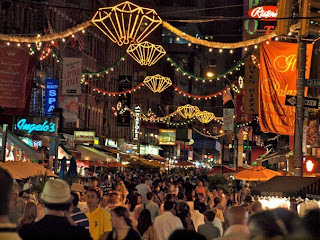 I loved the idea that instead of being typical tourists in a New York hotel, we were diving into New York life & living like other New Yorkers. The apartment was just as I had expected New York apartments to be: dirty & dingy on the outside, nice on the inside and views of the red brick apartment building next to yours and black laddered fire escapes. Teaming the gorgeous view from Brooklyn bridge and our awesome apartment, I fell asleep that first night convinced that I'd like to live in New York one day. Given that I'd only been in New York about an hour, I can say now that that thought was a little premature.
 I loved the idea that instead of being typical tourists in a New York hotel, we were diving into New York life & living like other New Yorkers. The apartment was just as I had expected New York apartments to be: dirty & dingy on the outside, nice on the inside and views of the red brick apartment building next to yours and black laddered fire escapes. Teaming the gorgeous view from Brooklyn bridge and our awesome apartment, I fell asleep that first night convinced that I'd like to live in New York one day. Given that I'd only been in New York about an hour, I can say now that that thought was a little premature.
(Image: Little Italy on a busy Friday night)
Now my knowledge of the geography of New York was very sketchy so I had to have it all explained to me by my Dad when we got there. For a start, I had no idea that it was a state. Did you??? Once I had that information though, things became a little easier to understand. New York is divided into boroughs - much like London - called Queens, Brooklyn, Manhattan, The Bronx and Staten Island. While in New York, we covered Midtown to Downtown Manhattan, including Ellis Island and Liberty Island, the home of the Statue of Liberty and drove through Brooklyn to get to & from the airport. We went around everywhere by subway and walking which I also liked because, according to Chandler in FRIENDS, no one drives a car in New York so we didn't either! Although our reasons were because it would be healthier & cheaper, not because Chandler said so.
I am going to start on a slightly negative note. I HATE THE SUBWAY. The only good thing is that its air-conditioned. It is so dirty & humid & full of crazy people! Don't get me wrong, I wasn't expecting some ultra modern and clean super system but I was expecting better than what it was. Having experienced the London Tube, I'm used to the dirtiness of travelling underground but the New York heat made being underground unbearable. The most sweating I did the entire week was a subway journey on a train that didnt have air-conditioning. It was awful.

On a more positive note, the sights we were going to see via the subway were pretty damn amazing. Times Square is the most beautiful symbol of consumerism I have ever seen, as your eyes are dazzled by endless flashing advertisements and giant posters of models. I could have lived in Central park easily. It really is an oasis and you can completely forget you are in the middle of a city and go for nature walks among beautiful trees, plants and lakes, go and watch softball games or sunbathe in endless fields (I did all three). Plus you can go and see the FRIENDS fountain! Chinatown is a unique shopping experience as you develop your haggling skills (my personal achievement was getting a bag down from $75 to $25) and a perfect chance to stock up on all the perfumes that are ultra expensive in London (I finally got my Vera Wang Princess - for $15!).
(Image: Times square)
I am a bit ambivalent about the shopping in New York. It is no mistake that there are plllllenty of shopping opportunities, but I unfortunately was disappointed. It isn't as cheap as I was hoping and I didn't find much that I wanted in the major places people go to like Century 21, Macys and (the love of my shopping life) Forever 21. I did however get to stock up on my Abercrombie & Fitch. I refuse on principle to buy it from the shop in London and I was in dire need. I have also developed a love for American Eagle jeans and stocked up on MAC makeup.
The food of New York was...different. Once again I was ambivalent. I absolutely loved most of it but found that eating the equivalent of what would have been two meals in London as one was a bit much on my stomach. I gained half a stone in a week. Plus the lack of places that sold apple juice and meals without bread of any kind disconcerted me. I will say however that I totally prefer food shopping in deli's to supermarkets. As deli's are quite rare in London, is was quite a cool experience to handpick everything you bought.
The people of New York was something I only really experienced through the subway and while in restaurants or shopping. It was really nice being greeted and asked how I was every time I walked into a shop but on the subway, it was very much like London, where everyone just minds their own business and keeps to themselves. I therefore remain undecided and will make no opinion of the New York people until I have met ones who are not in a situation where they are at work and obligated to be kind to me, nor on public transport. I will say that they seem lovely enough though!
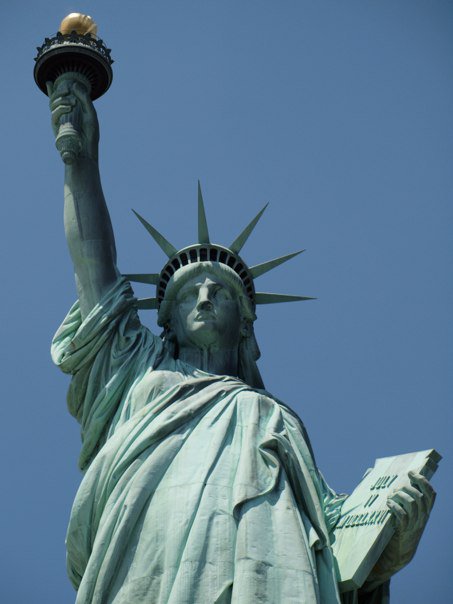
The visits to Ellis and Liberty island were really interesting. From 1892 to 1954, Ellis island was the portal for over 12 million immigrants into the US. Liberty Island is the home of the Statue of Liberty. I love the symbolism of freedom behind the two places and the thought of the millions of immigrants that would have passed through Ellis island was very overwhelming. I didn't however, have the major connection with the two places that many people do. Perhaps it is because, to me and my ancestry, Ellis island and the statue of liberty have never really had anything to with us. Despite being a beautiful monument, for me, that was all it was - a monument. Who knows, perhaps I'm harbouring some secret dislike for Lady Liberty because the liberty she gained is from the tyrannical British? I seriously doubt it though.
(Image: the Statue of Liberty)
 (Image: the globe crushed by the twin towers)
There was one place, however, that I did have a very strong connection with. Ground Zero. When we went to where the Twin Towers had originally stood, we were met with scaffolding and major building works as the building of the ground zero monument continued but that did nothing to prevent the reality of what happened hitting me. All around the site were more buildings and people and thought that they collapsed into this cramped little space was overwhelming. Everywhere you went in New York you could see signs of the effect of 9/11. On the front of many fire & police stations were plaques for service men that died saving others on that day. In Central park there is a globe that was crushed when the twin towers fell on top of it then rebuilt as a monument and has to be the most thought provoking, emotional & symbolic art work I have ever seen. Even going to times square, which was covered in police officers after the recent terrorist attempt there. What I loved was that despite what happened, the city wasn't coated with fear or suspicion but continued being just as amazing as it had always been, standing up to terrorism by showing its strength and ability for everyone to unite together. That being said, at the time I knew nothing of the protests that were going on against a mosque being built near ground zero. I personally consider them to be the minority that have allowed their fear to control them and turned their fear to hate.
All in all, I really enjoyed New York. It was an interesting place to visit with good food, good people and good sights. But, in all honestly, I didn't live up to the 'greatest' reputation and while I would like to go back to see more of the other boroughs in New York, it hasn't made it onto my list of places I want to live. What do you think? Did I miss something? Is there something I should have done or seen that I didn't? Am I missing the big picture? I don't know, maybe.
In a sentence, my review of New York would be "good, but not great" or perhaps "Chicago's better".
Friday, 20 August 2010
Today's celebrations August 20th
Labels:
Celebrations,
Estonia,
Hungary,
Montserrat,
Morocco,
USA
0
comments
Today is...

Constitution Day in Hungary
National Day in Hungary
National Homeless Animals Day in the United States of America
Restoration of Independence Day in Estonia
St. Stephen's Day in Hungary
The King & People's Revolution in Morocco
Montserrat Annual Pilgrimage in Montserrat
Thursday, 19 August 2010
Today's celebrations 19th August
Labels:
Afghanistan,
Celebrations,
Montserrat,
Norway,
Russia,
USA,
Vietnam
0
comments
Today is...

Apple Spas in Russia
Day of the Failed August, 1991 Coup in Russia
Independence Day in Afghanistan
National Aviation Day in the United States of America
Revolution of 1945 in Vietnam
Birth of Crown Princess Mette Marit in Norway
Montserrat Annual Pilgrimage in Montserrat
Friday, 28 May 2010
Black Studies
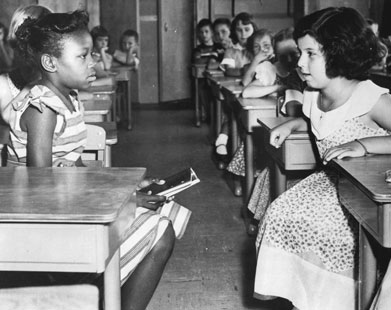 Black Studies
Black studies is defined as the study of African-Americans, their culture, and contributions to society. Black studies covers aspect of the institution of slavery and progression of segregation in post-civil war United States. Likewise, the African-Americans had triumphed throughout these perilous times. African-American leaders began to emerge and create movements that would establish a Black identity; some of these movements include the Black Arts Movement, The Nation of Islam, Civil Rights Movement, Black Power Movement, and the Black Nationalist Movement/ Universal Negro Improvement Association.
The Black Nationalist Movement was one of the most groundbreaking movements of Black history. This movement was a political and social movement which promoted the education and political recognition of black Americans.[1] Some people have traced this movement Marcus Garvey’s Universal Negro Improvement Association. This association sought to gain economic power and incorporate blacks into the idea of a community.
Likewise, The Black Nationalist Movement under Gravey’s leadership was primarily based to enhance the life of African-Americans. This movement had two core values which were black pride and racial separatism, ideally Gravey wanted African-Americans completely separate from white society. Judging by what caused these movements they accurately represent responses from a hostile white society. I take reference from a book titled the Production of the Afro-American where it reads “black nationalists maintain that in order for Afro-Americans to liberate themselves from oppression, some degree of autonomy from the dominant society is essential.” Marcus Garvey strongly believed that this separation would allow for blacks to take control of their communities, maintain economic stability, and promote peaceful living environments. [2]
In addition, while looking at the Black Nationalist Movement we must not forget the movement of the Nation of Islam by Malcolm X. This movement was a religious movement that captivated hundreds and thousands of African-Americans, so much that they converted to the religious Islamic practice. During this movement the Nation of Islam taught Muslim beliefs, created black businesses and schools, and rehabilitated former drug addicts into their former functional selves[3]. These participants of this movement were perceived to be the conscious of blacks and ones who would help blacks to achieve some form of success. Many people began to follow this movement because to some it is because of the Nation of Islam that they got their lives back and enjoyed life as they did before drugs.
In contrast, this movement became under fire when the Civil Rights Movement began by Dr. Martin Luther King Jr. The Civil Rights Movement was a movement of protests and political action by thousands of American citizens. The start of such a monumental movement has been attributed to Rosa Parks a woman whom refused to give up her seat on a bus to a white man. This is the spark that had lead to one of the biggest boycotts in American history.[4] These boycotts would lead to certain businesses economic demise since there would not be any protestor’s patronizing their businesses. This movement is known for being a non-violent movement. Police would resort to inhumane methods of crowd control by hosing people down and attacking them with dogs, yet the protestors stood their strong waiting for their voice to be heard.
Lastly, the Black Power movement was a movement started by the Black Panthers. This movement was hailed as the positive force that helped blacks achieve full equality with whites. This movement installed a since of racial pride, self-esteem, and promotion of political participation.[5] The Black Power movement encouraged individuals to instill racial pride and unity. It is from this movement that the Black Art Movement occurred where young black poets, authors, and visual artists found their voices and shared those voices with others. This movement sought out a black audience.
It is through these different movements that the emergence of Black Studies emerged. The objective is to analyze the economic and political reason for slavery in America, provide valuable information regarding blacks and their lives in America. In addition to providing the role of geography plays a role in determining slavery and its effects on the world.
Ancient Kemet played a major role in World History since it established one of the first educational systems the world has ever seen. Egyptian believed that their purpose in life was to live and become a God, this created a society that is heavily based on its divinity. Formal education was one way Egyptians used to attain life’s purpose. Kemet’s scholars taught the Seven Liberal Arts in the Mystery Schools to liberate the person’s soul from its body, which would allow the student to ultimately reach the level of Spiritual Consciousness. Education was to bring out and develop the “good” or “divine” already inside a person. For example, Studying Grammar, Rhetoric and Logic, for example, would remove a person’s “irrational tendencies of behavior” because these subjects were conveyors for moral development. [6]
The legacy of Egypt is debated because it flourished around 3000 B.C. which is inconceivable to those who view Jerusalem as the start of civilization. In addition to this, the idea the Africans began and maintained one of the most advanced civilizations on the planet seems inconceivable. This starts a debate which has lasted hundreds of years .The Kemet tradition naturally belongs to the blacks.[7] We were here before the colonization of Egypt and therefore the land quite naturally belongs to the Africans. During this time the whites came and occupied this land which they exploited for their own goods since it has close proximity to the Nile River.
It is important to study Ancient Egypt and Classical African Civilizations be integrated into African-American studies since it is an ancient civilization in Africa. Egypt should not be taken out of studies because it was originally Kemet which is a part of Africa, there has only been a name change. The contributions of this people and their society should still be noted in African-American studies. This helps in establishing a foundation in African-American studies; it allows us to see exactly what our people had to endure and the hardships that we had to endure. Without doing so the history of African-Americans will remain untold, this creates a perception of partial truths. The complete history of African-Americans should be explored.
The purpose of both of these compromises were to stop the spreading of slavery, although they had similar motives their methods could not be any different. By 1818, the state of Missouri had gained enough population to be entered into the Union. Due to its settlers coming from the South it was expected that Missouri would become a slave state. [8] In 1819, Representative James Tallradge proposed an amendment to ban slavery in Missouri, which is what the South’s economy was based upon. It is through Sen. Henry Clay this compromise was created. The Missouri Compromise stipulated that all the Louisiana Purchase territory north of the southern boundary of Missouri, except Missouri, would be free, and the territory below that line would be slave.
In opposition, the Kansas-Nebraska Act was created. The act was created when Senator Stephen Douglas wanted to build a transcontinental railway which had to pass through the Nebraska. Douglas suggested that the territory become two states, Nebraska entering as a free state and Kansas deciding by popular sovereignty. [9]This nullified the Missouri Compromise entirely however the South agreed. People in the North against the expansion of slavery paid for people to move to Kansas and vote against slavery. This angered the South and resulted in Southerners crossing the border on voting day to vote in for slavery. Violence erupted and a civil war broke out in 'bleeding Kansas'.[10] This can be called the spark of the Civil War since it successfully put the Northerners and the Southerners at war with each other.
[1] Gordon, Dexter. Black Identity: Rhetoric, Ideology, and Nineteenth-Century Black Nationalism (Southern Illinois Univerisity Press, 2003), 37
[2] Gordon, Dexter. Black Identity: Rhetoric, Ideology, and Nineteenth-Century Black Nationalism (Southern Illinois Univerisity Press, 2003), 39
[3]PBS. “The Story of the Movement-The Nation of Islam and Malcolm X”. PBS. http://www.pbs.org/wgbh/amex/eyesontheprize/story/11_noi.html (accessed March 11, 2010)
[4] Levy, Peter. The Civil Rights (London: Greenwood Press Westport, 1998) 127
[5] James McEvoy and Abraham Miller. Black Power and Student Rebellion. (Belmont, CA: Wadsworth Publishing, 1969), 233
[6] Suite101. Ancient Kemet’s World View. Suite 101. http://africanhistory.suite101.com/article.cfm/ancient_kemets_world_view (accessed March 13, 2010)
[7] Henderson, Anthony. Afrocentrism and World Politics: Towards a New Paradigm. (Wesport, CT: Praeger Publishers, 1995), 89
[8] Jones, Charles. Missouri: The Heart of the Nation. (Wheeling, IL: Harlan Davidson Publishing, 2004), 110
[9] Goodrich, Thomas. War to knife: Bleeding Kansas, 1854-1861. (Lincoln, NE: University of Nebraska Press., 2004), 42
[10] Civil War. Secession Crisis. http://civilwar.bluegrass.net/secessioncrisis/200303.html (accessed March 14, 2010)
[6] Suite101. Ancient Kemet’s World View. Suite 101. http://africanhistory.suite101.com/article.cfm/ancient_kemets_world_view (accessed March 13, 2010)
[7] Henderson, Anthony. Afrocentrism and World Politics: Towards a New Paradigm. (Wesport, CT: Praeger Publishers, 1995), 89
[8] Jones, Charles. Missouri: The Heart of the Nation. (Wheeling, IL: Harlan Davidson Publishing, 2004), 110
[9] Goodrich, Thomas. War to knife: Bleeding Kansas, 1854-1861. (Lincoln, NE: University of Nebraska Press., 2004), 42
[10] Civil War. Secession Crisis. http://civilwar.bluegrass.net/secessioncrisis/200303.html (accessed March 14, 2010)
Subscribe to:
Posts (Atom)


 Posts
Posts


