Showing posts with label country comparisons. Show all posts

Wednesday, 8 September 2010

The Longest Place Names In The World!

0 comments
Llanfairpwllgwyngyllgogerychwyrndrobwyllllantysiliogogogoch - North Wales

This town has become famous because of its long name. It has the longest train station name in the UK. The name translates as "St Mary's Church in the hollow of the white hazel near a rapid whirlpool and the Church of St Tysilio of the red cave". To have a go at trying to say the name, click here!


Taumatawhakatangihangakoauauotamateapokaiwhenuakitanatahu - New Zealand

Taumata whakatangihanga koauau o tamatea turi pukakapiki maunga horo nuku pokai whenua kitanatahu is the Māori name for a hill, 305 metres (1,001 ft) high in New Zealand.It has gained a measure of fame as it is the longest place-name found in any English-speaking country.

The name on the sign that marks the hill is "Taumata whakatangihanga koauau o tamatea turi pukakapiki maunga horo nuku pokai whenua kitanatahu", which translates roughly as The summit where Tamatea, the man with the big knees, the climber of mountains, the land-swallower who travelled about, played his nose flute to his loved one. At 85 letters, it has been listed in the Guinness World Records as one of the longest place names in the world.

Other forms of the name are longer still: "Taumata whakatangihanga koauau o tamatea ure haea turi pukaka piki maunga horo nuku pokai whenua ki tana tahu" has 92 letters. An even longer version, Taumata-whakatangihanga-koauau-o-Tamatea-haumai-tawhiti-ure-haea-turi-pukaka-piki-maunga-horo-nuku-pokai-whenua-ki-tana-tahu, has 105 letters and means The hill of the flute playing by Tamatea — who was blown hither from afar, had a slit penis, grazed his knees climbing mountains, fell on the earth, and encircled the land — to his beloved.

To have a try at saying this name, click here!

Krung Thep Mahanakhon Amon Rattanakosin Mahinthara Yuthaya Mahadilok Phop Noppharat Ratchathani Burirom Udomratchaniwet Mahasathan Amon Piman Awatan Sathit Sakkathattiya Witsanukam Prasit - Thailand

This is the ceremonial name of Bangkok, Thailand, in Thai; it has the Guinness World record for longest place name in the world. The translation is:
krungthep mahanakhon
The land of angels, the great city of
amorn rattanakosin
immortality, various of devine gems,
mahintara yudthaya mahadilok pohp
the great angelic land unconquerable,
noparat rajathanee bureerom
land of nine noble gems, the royal city, the pleasant capital,
udomrajniwes mahasatarn
place of the grand royal palace,
amorn pimarn avaltarnsatit
forever land of angels and reincarnated spirits,
sakatattiya visanukram prasit
predestined and created by the highest devas

Chargoggagoggmanchauggagoggchaubunagungamaugg - USA

This is the longest place name in the United States at 45 letters and is a lake in Webster, Massachusetts. It means "Fishing Place at the Boundaries — Neutral Meeting Grounds" and is sometimes facetiously translated as "you fish your side of the water, I fish my side of the water, nobody fishes the middle". The lake is also known as Lake Webster.


Mamungkukumpurangkuntjunya Hill - Australia

The longest official geographical name in Australia is Mamungkukumpurangkuntjunya Hill. It has 26 letters and is a Pitjantjatjara word meaning "where the Devil urinates".

Muckanaghederdauhaulia - Ireland

In Ireland, the longest English placename at 22 letters is Muckanaghederdauhaulia (from the Irish language, Muiceanach Idir Dhá Sháile, meaning "pig-marsh between two saltwater inlets") in County Galway.

Tweebuffelsmeteenskootmorsdoodgeskietfontein - South Africa

Tweebuffelsmeteenskootmorsdoodgeskietfontein is the name of a farm in South Africa and is Afrikaans for "The spring (lit. Fountain) where two buffaloes were cleanly killed with a single shot", which follows a common format for place names in South Africa. It is uncertain as to whether Tweebuffelsmeteenskootmorsdoodgeskietfontein is the name of a farm, or a small town in South Africa, as various sources state either of these two as being correct.

Äteritsiputeritsipuolilautatsijänkä - Finland

Äteritsiputeritsipuolilautatsijänkä is a bog region in Savukoski, Lapland in Finland. The name is 35 letters long and is the longest place name in Finland.

Pekwachnamaykoskwaskwaypinwanik - Canada

This is a lake in Manitoba and Nunavut, in the Inuktitut language and at 31 letters is the longest official one-word placename in Canada.

Venkatanarasimharajuvaripeta - India

Venkatanarasimharajuvaripeta is a village in Andhra Pradesh, India. It is in the Telugu language and is the longest place name in India. It is also a railway station in Andhra Pradesh on the border with Tamil Nadu, India with the distinction of having the longest name among all stations on the Indian Railway system.

Gasselterboerveenschemond - Netherlands

Gasselterboerveenschemond is a hamlet in the Dutch province of Drenthe.It is the largest town name of The Netherlands that is written as one word. With 25 characters it is just one character larger than Gasselternijveenschemond, which lies a few kilometres from Gasselterboerveenschemond. To try to say the name, click here!


Parangaricutirimicuaro - Mexico

Nuevo San Juan Parangaricutiro, in the Mexican state of Michoacán, is a small village near the Parícutin volcano. The city is called "Nuevo" (Spanish for "New") because the original San Juan Parangaricutiro was destroyed during the formation of the Parícutin volcano in 1943.San Juan Parangaricutiro is also famously known as Parangaricutirimícuaro, the longest place name word in Mexico. Some believe that “Parangaricutirimícuaro” is an urban legend and does not exist. It is the object of the folklore of many fictitious fables. The word itself is a tongue-twister and it is also used in longer tongue-twisters that include nonsense words similar to Parangaricutirimícuaro.To try to say the name click here!

Information from:

Saturday, 4 September 2010

Say Hello Around The World

0 comments
We found this great video on youtube by a very upbeat guy showing you how to say hello in 25 different languages! (although some of the video comments say he has said things wrong so if you spot any mistakes, comment and tell us what they are so we don't make them too!)


Tuesday, 31 August 2010

Thought Black People Had It Tough? Try Being Untouchable.

3 comments
Living in the West, when I hear about discrimination I think of gender, race, religion and even age. One word that doesn't come to mind is caste but for an estimated 250 million people worldwide, caste discrimination is a serious problem. A caste is a combined social system of occupation, endogamy (marriage within a specific ethnic group), culture, social class, and political power. According to UNICEF, discrimination based on caste is prevalent mainly in parts of Asia and Africa.

The Indian caste system is comprised of four different castes, and outcasted social groups. Caste barriers have mostly broken down in large cities, though they persist in rural areas of the country, where 72% of India's population resides. In some rural areas and small towns, the caste system is still very rigid. The Government of India has officially documented castes and sub-castes, primarily to determine those deserving reservation (positive discrimination in education and jobs) through the census. The Indian reservation system, though limited in scope, relies entirely on quotas. The Government lists consist of Scheduled Castes, Scheduled Tribes and Other Backward Classes.The caste-based reservations in India have led to widespread protests, such as the 2006 Indian anti-reservation protests, with many complaining of reverse discrimination against the forward castes (the castes that do not qualify for the reservation). Many view negative treatment of forward castes as socially divisive and equally wrong.

Independent India has witnessed a considerable amount of violence and hate crimes motivated by caste. Various incidents of violence against Dalits have been reported from many parts of India. Dalit is a self-designation for a group of people traditionally regarded as of lower class and unsuitable for making personal relationships. Dalits are a mixed population of numerous caste groups all over South Asia, and speak various languages.According to a report by Human Rights Watch, "Dalits and indigenous peoples (known as Scheduled Tribes or adivasis) continue to face discrimination, exclusion, and acts of communal violence. Laws and policies adopted by the Indian government provide a strong basis for protection, but are not being faithfully implemented by local authorities."

What disturbed me most when I was researching the violence against Dalits in India was the number of massacres, the latest one being the Kherlanji massacre in 2006. On September 29, 2006, four members of the Bhotmange family belonging to the Dalit underclass were slaughtered in Kherlanji, a small village in Bhandara district of Maharashtra. The women of the family, Surekha and Priyanka, were paraded naked in public then allegedly gang-raped before being murdered. Although initially ascribed by the media and by the Human Rights Watch to upper castes, the criminal act was actually carried out by Kunbi caste (classified as Other Backward Classes by Government of India) farmers for having opposed the requisition of the Dalit land to have a road built over it.


The Nepalese caste system, like the Indian caste system, is highly complex and continues the traditional system of social stratification of Nepal. The castes of Nepal have been placed into 5 hierarchies with the following order of precedence:
  • Thagadhari, (Wearer of holy cord)
  • Matwali
  • Namasyane Matwali (Non-enslavable alcohol-drinkers)
  • Masyane Matwali (Enslavable alcohol drinkers)
  • Pani nachalne choichoto halnu naparne, (Impure but touchable castes)
  • Pani nachalne chiochoti halnu parne, (Impure and Untouchable castes)
The supreme caste communities make ornaments, weapons pottery and others. The castes have different names: Kamis (Iron-smiths), Sunars (Gold-smiths), Lohars (Iron smiths), Vishwakarmas (V.K.), Sobh, Snehi Nepali, etc. They have been named after the professions they are found to be engaged in. For instance, one who is engaged in works related to gold is a Sonar; one who constructs a house or makes pots is an Od; the person who makes things out of copper is a Tamta.

However, Nepalese society is clearly split into touchables and untouchables as touchables have no marital relation with them, and do not allow them to enter their houses. The situation of caste-based untouchability existing in the country depends heavily on what region of the country you are in. Untouchability exists in its extreme form especially in the hills and mountains of the remote western region. Untouchable castes have been prohibited from their entrance into temples and other public places. For instance, the untouchables are not allowed to enter the fair held annually at Dehimandau in Baitadi district and open stalls. They have to sit outside restaurants and wash eating utensils. At many places there also exists the practice of sprinkling water for purification. Milk and milk products are not given to the untouchables to drink and eat.Untouchable boys and girls are discriminated even at public schools. They have to use separate pots for drinking water. They have also to sit separately in the class as ink is defiled with their touch.

With the advent of democracy in 1950, social discriminations started breaking down not because of any legal provisions but because of the high caste people's own initiatives. However, even this change could not abolish untouchability. Though public places were opened to low caste people in some places, the situation remained unchanged to a large extent. There has been made a legal sanction in the civil code against untouchability; however, it has turned out to be meaningless since its violation is not liable to any specific penalty.

In West Africa, the Osu caste system in Nigeria and southern Cameroon, can be traced back to an indigenous religious belief system, practiced within the Igbo nation. It is the belief of many Igbo traditionalists that the Osus are people historically owned by deities, and are therefore considered to be a 'living sacrifice', an outcaste, untouchable and sub-human. People regarded as modern-day Osu in Igboland are descendants of individuals who volunteered and were sacrificed to the various gods. These fore-fathers pledged themselves and their descendants to these gods. They enjoyed protection and privileges but were segregated from ordinary people. Osu people married, fraternized and socialized among themselves. This practice continues to this day. An ordinary Igbo person would not marry or permit any of his relations to marry an Osu person. In the few instances where this has happened, the non-Osu who married the Osu became infested and was from then on regarded as Osu.

The East African caste system in Rwanda, Burundi and eastern Congo it is known as ubuhake. The Tutsi, who comprise about 15% of the population of these areas were the ruling, Cattle-owning caste. Below them were the Hutu, the farmers who made up about 80% of the population. Fewer than 3% of the population are Twa or Pygmies. During the German authorative control over Rwanda and Burundi, the authorities reinforced the system by employing Tutsis in hegemonic (dominating, leaders) roles. The Belgian colonialists who succeeded them after World War I continued this policy, instituting 'ethnic' identity cards. After independence, tensions intensified. In 1972, Tutsis were responsible for a wholesale massacre of Hutus. In the 1990s, Hutus responded with counter-massacres. See our posts on the Rwandan Genocide to find out more (in the posts for Rwanda under 'around the world...').

While many of the discrimination towards 'untouchables' and other 'low' castes is similar to the discrimination of ethnic minorities under white people in the west, the disturbing difference is that the discrimination against so-called 'untouchables' IS STILL HAPPENING. Imagine it. Martin Luther King's dream never happened. Equality never happened. There are still signs outside shops saying "No Dogs, No Negroes". For that to still exist in the 21st century would be unacceptable and unthinkable so why is it any different for castes? I personally think a lot of it is ignorance. We simply don't know what's going on. Even I am guilty. I had heard the term 'untouchable' many times but, never knowing what it was, assumed it was an insulting name for people with leprosy or something like that. I knew a lot about the Rwandan genocide but never realised that it wasn't just a one-off situation. This post only contains a raindrop of the ocean of countries across the globe with castes and caste systems.

It can be easy to shrug and say 'what can we do?' but something CAN be done. There have been many countries like Korea, Hawai, Japan, Spanish America and England that used to have castes systems and don't any longer. There are also countries like Bali that have castes systems but there are no 'untouchables' and there is mobility within the castes so one family can contain many castes and they can marry one another. This discrimination is wrong and the first step to beating it is telling everyone its out there, its wrong and we aren't going to accept it. Tell some friends, work with the charities and touch an untouchable.

Information from:

Tuesday, 24 August 2010

The Disappointments Of An English Woman In New York

0 comments
New York. The Big Apple. The city that never sleeps. You would be far stretched to find someone who hasn't lived in/wanted to go to/visited/at least heard of New York. Except perhaps a few tribes in the Amazon but I wouldn't be surprised if they hid postcards of Lady Liberty under their pillows or sang Sinatra's New York New York at celebrations. (Just an interesting cultural note for those of you that don't know, New York New York is one of the most common songs to be played at the reception of British weddings).

For me, New York was a source of great interest for many reasons: 1) How I Met Your Mother & F.R.I.E.N.D.S is set in New York 2) its reputation as one of the greatest and most diverse cities in the world is something I had to explore 3) according to my best friend, the shopping is incredible. OK, so perhaps not the most deep & philosophical reasons for wanting to visit somewhere, but those were my reasons none the less. You can imagine my excitement therefore my my Dad told me that our family holiday 2010 would be to New York city itself! I immediately got a job and starting saving up money, dreaming of all the dresses and shoes that could soon be mine. And, given that New York is the city where dreams come true, I was certain they would be.

July arrived nice and quickly and before I knew it I was being welcomed to New York after an 8 hour flight of watching terrible films (Alice In Wonderland, the Bounty Hunter & Valentine's Day - I recommend none of them. They are all disappointments.) and uncomfortable fidgeting after failing to sleep. We (and just to clarify ahead of time, 'we' is myself, my two younger brothers, my father, my step-mum and two younger step-brothers) were staying in an apartment above a restaurant in Little Italy but had to drive from Brooklyn first to get there. I can tell you right now, that the view of Manhattan from Brooklyn bridge at night is one of the most beautiful things I have ever seen and left me instantly smitten.

I loved the idea that instead of being typical tourists in a New York hotel, we were diving into New York life & living like other New Yorkers. The apartment was just as I had expected New York apartments to be: dirty & dingy on the outside, nice on the inside and views of the red brick apartment building next to yours and black laddered fire escapes. Teaming the gorgeous view from Brooklyn bridge and our awesome apartment, I fell asleep that first night convinced that I'd like to live in New York one day. Given that I'd only been in New York about an hour, I can say now that that thought was a little premature.
(Image: Little Italy on a busy Friday night)

Now my knowledge of the geography of New York was very sketchy so I had to have it all explained to me by my Dad when we got there. For a start, I had no idea that it was a state. Did you??? Once I had that information though, things became a little easier to understand. New York is divided into boroughs - much like London - called Queens, Brooklyn, Manhattan, The Bronx and Staten Island. While in New York, we covered Midtown to Downtown Manhattan, including Ellis Island and Liberty Island, the home of the Statue of Liberty and drove through Brooklyn to get to & from the airport. We went around everywhere by subway and walking which I also liked because, according to Chandler in FRIENDS, no one drives a car in New York so we didn't either! Although our reasons were because it would be healthier & cheaper, not because Chandler said so.

I am going to start on a slightly negative note. I HATE THE SUBWAY. The only good thing is that its air-conditioned. It is so dirty & humid & full of crazy people! Don't get me wrong, I wasn't expecting some ultra modern and clean super system but I was expecting better than what it was. Having experienced the London Tube, I'm used to the dirtiness of travelling underground but the New York heat made being underground unbearable. The most sweating I did the entire week was a subway journey on a train that didnt have air-conditioning. It was awful.

On a more positive note, the sights we were going to see via the subway were pretty damn amazing. Times Square is the most beautiful symbol of consumerism I have ever seen, as your eyes are dazzled by endless flashing advertisements and giant posters of models. I could have lived in Central park easily. It really is an oasis and you can completely forget you are in the middle of a city and go for nature walks among beautiful trees, plants and lakes, go and watch softball games or sunbathe in endless fields (I did all three). Plus you can go and see the FRIENDS fountain! Chinatown is a unique shopping experience as you develop your haggling skills (my personal achievement was getting a bag down from $75 to $25) and a perfect chance to stock up on all the perfumes that are ultra expensive in London (I finally got my Vera Wang Princess - for $15!).

(Image: Times square)

I am a bit ambivalent about the shopping in New York. It is no mistake that there are plllllenty of shopping opportunities, but I unfortunately was disappointed. It isn't as cheap as I was hoping and I didn't find much that I wanted in the major places people go to like Century 21, Macys and (the love of my shopping life) Forever 21. I did however get to stock up on my Abercrombie & Fitch. I refuse on principle to buy it from the shop in London and I was in dire need. I have also developed a love for American Eagle jeans and stocked up on MAC makeup.

The food of New York was...different. Once again I was ambivalent. I absolutely loved most of it but found that eating the equivalent of what would have been two meals in London as one was a bit much on my stomach. I gained half a stone in a week. Plus the lack of places that sold apple juice and meals without bread of any kind disconcerted me. I will say however that I totally prefer food shopping in deli's to supermarkets. As deli's are quite rare in London, is was quite a cool experience to handpick everything you bought.

The people of New York was something I only really experienced through the subway and while in restaurants or shopping. It was really nice being greeted and asked how I was every time I walked into a shop but on the subway, it was very much like London, where everyone just minds their own business and keeps to themselves. I therefore remain undecided and will make no opinion of the New York people until I have met ones who are not in a situation where they are at work and obligated to be kind to me, nor on public transport. I will say that they seem lovely enough though!

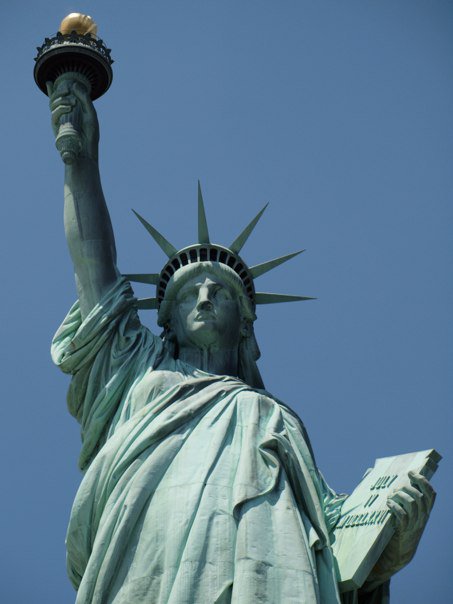
The visits to Ellis and Liberty island were really interesting. From 1892 to 1954, Ellis island was the portal for over 12 million immigrants into the US. Liberty Island is the home of the Statue of Liberty. I love the symbolism of freedom behind the two places and the thought of the millions of immigrants that would have passed through Ellis island was very overwhelming. I didn't however, have the major connection with the two places that many people do. Perhaps it is because, to me and my ancestry, Ellis island and the statue of liberty have never really had anything to with us. Despite being a beautiful monument, for me, that was all it was - a monument. Who knows, perhaps I'm harbouring some secret dislike for Lady Liberty because the liberty she gained is from the tyrannical British? I seriously doubt it though.

(Image: the Statue of Liberty)

(Image: the globe crushed by the twin towers)
There was one place, however, that I did have a very strong connection with. Ground Zero. When we went to where the Twin Towers had originally stood, we were met with scaffolding and major building works as the building of the ground zero monument continued but that did nothing to prevent the reality of what happened hitting me. All around the site were more buildings and people and thought that they collapsed into this cramped little space was overwhelming. Everywhere you went in New York you could see signs of the effect of 9/11. On the front of many fire & police stations were plaques for service men that died saving others on that day. In Central park there is a globe that was crushed when the twin towers fell on top of it then rebuilt as a monument and has to be the most thought provoking, emotional & symbolic art work I have ever seen. Even going to times square, which was covered in police officers after the recent terrorist attempt there. What I loved was that despite what happened, the city wasn't coated with fear or suspicion but continued being just as amazing as it had always been, standing up to terrorism by showing its strength and ability for everyone to unite together. That being said, at the time I knew nothing of the protests that were going on against a mosque being built near ground zero. I personally consider them to be the minority that have allowed their fear to control them and turned their fear to hate.

All in all, I really enjoyed New York. It was an interesting place to visit with good food, good people and good sights. But, in all honestly, I didn't live up to the 'greatest' reputation and while I would like to go back to see more of the other boroughs in New York, it hasn't made it onto my list of places I want to live. What do you think? Did I miss something? Is there something I should have done or seen that I didn't? Am I missing the big picture? I don't know, maybe.

In a sentence, my review of New York would be "good, but not great" or perhaps "Chicago's better".

Friday, 21 May 2010

Dance around the world: Jazz dance, hip hop dance, Kathak, Funga

0 comments
Jazz Dance

Jazz dance is a classification shared by a broad range of dance styles. Prior to the 1950s, jazz dance referred to dance styles that originated from African American vernacular dance. In the 1950s, a new genre of jazz dance—modern jazz dance—emerged, with roots in Caribbean traditional dance. Every individual style of jazz dance has roots traceable to one of these two distinct origins.


Hip hop Dance

Hip-hop dance refers to social or choreographed dance styles primarily danced to hip-hop music or that have evolved as part of hip-hop culture. This includes a wide range of styles notably breaking, locking, and popping which were developed in the 1970s by Black and Latino Americans. What separates hip-hop dance from other forms of dance is that it is often freestyle in nature and hip-hop dancers frequently engage in battles—formal or informal freestyle dance competitions. Internationally, hip-hop dance has had a particularly strong influence in France and South Korea.


Kathak

Kathak is one of the eight forms of Indian classical dances, originated from northern India. This dance form traces its origins to the nomadic bards of ancient northern India, known as Kathaks, or storytellers. These bards, performing in village squares and temple courtyards, mostly specialized in recounting mythological and moral tales from the scriptures, and embellished their recitals with hand gestures and facial expressions.


Funga

The Funga is a welcome and harvest dance from the Vai people of Liberia. It is made up of two dances brought to the West in the 1930’s and 1940’s by Pearl Primus. It is the "Swan Lake of African Dance" because it is the most widely known and done of the African dances.


Information from:
http://en.wikipedia.org/wiki/Hip-hop_dance
http://library.thinkquest.org/J002266F/africa.htm
http://en.wikipedia.org/wiki/Kathak
http://en.wikipedia.org/wiki/Jazz_dance

Dance around the world: Line Dance, North African Gypsy Dance, Fandango, Bhangra

0 comments
Line Dance

A line dance is choreographed dance with a repeated sequence of steps in which a group of people dance in one or more lines or rows without regard for the gender of the individuals, all facing the same direction, and executing the steps at the same time. Line dancers are not in physical contact with each other. It is most commonly associated with the USA where it is danced to country western music.


North African Gypsy Dance


Fandango

Fandango is a lively folk and Andalusian (flamenco) couple-dance usually in triple metre, traditionally accompanied by guitars and castanets or hand-clapping (palmas in Spanish and Portuguese).Fandango is one of the main folk dances in Portugal.


Bhangra

Bhaṅgṛā is a form of music and dance that originated in the Punjab region of India and Pakistan. Bhangra dance began as a folk dance conducted by Punjabi farmers to celebrate the coming of Vaisakhi, a Punjabi festival. The specific moves of Bhangra reflect the manner in which villagers farmed their land. This musical art further became synthesized after the partition of India, when refugees from different parts of the Punjab shared their folk dances with individuals who resided in the regions they settled in. This hybrid dance became Bhangra. The folk dance has been popularised in the Western World by South Asian communities and is seen in the West as an expression of Indian and Pakistani culture as a whole. Today, Bhangra dance survives in different forms and styles all over the globe – including pop music, film soundtracks, collegiate competitions and even talent shows.


Information from:
http://en.wikipedia.org/wiki/Line_dance
http://en.wikipedia.org/wiki/Fandango
http://en.wikipedia.org/wiki/Bhangra

Buddha's Birthday

0 comments

Buddha's Birthday, the birthday of the Prince Siddhartha Gautama is a holiday traditionally celebrated in Mahayana Buddhism.In all east Asian countries except Japan it is held on the 8th day of the 4th month in the Chinese lunar calendar, and the day is an official holiday in Hong Kong, Macau, and South Korea.

Japan

As same as other traditional holidays like New year, Japanese culture "translates" every traditional festival's date into Gregorian calendar's one. The 4th month in Chinese Lunar Calendar is translated into April or May. Therefore Buddha's Birthday is celebrated on April 8 or May 8 in many Japanese temples.In Japan, Buddha's Birthday is also celebrated according to the Buddhist calendar but is not a national holiday. On this day, all temples do celebratory events/festivals called Kanbutsu-e, meaning 'Flower Festival'. The first event was held at Asuka-dera in 606. Japanese people pour ama-cha (a beverage prepared from a variety of hydrangea) on small Buddha statues decorated with flowers, as if bathing a newborn baby.

India

Birth of Buddha or Tathagata is celebrated in India, especially in Sikkim, Ladakh , Arunachal Pradesh, Bodh Gaya and Maharashtra (where 6% of total population are Buddhists) and other parts of India as per Indian calendar. Buddhist People go to common Viharas to observe a rather longer-than-usual, full-length Buddhist sutra, as something like a service. The usual dress is pure white. Non-vegetarian food is normally avoided. Kheer, a sweet rice porridge is commonly served to recall the story of Sujata, a maiden who, in Gautama Buddha's life, offered the Buddha a bowl of milk porridge.

Nepal

The birth of the Buddha is often celebrated by Buddhists in Nepal for an entire month in the Buddhist calendar. The actual day is called Buddha Poornima (or Buddha Purnima), also traditionally known as Vaishakh Poornima. Although the day marks not just the birth of Shakyamuni Gautam Buddha, but also the day of Enlightenment, and Mahaparinirvana. But as a gentle effect of West, the event of Birth is given paramount importance. The event is celebrated by gentle and serene fervour, keeping in mind the very nature of Buddhism. People, especially women, go to common Viharas to observe a rather longer-than-usual, full-length Buddhist sutra, as something like a service. The usual dress is pure white. Non-vegetarian food is normally avoided. Kheer, a sweet rice porridge is commonly served to recall the story of Sujata, a maiden who, in Gautama Buddha's life, offered the Buddha a bowl of milk porridge after he had given up the path of asceticism following six years of extreme austerity. This event was one major link in his enlightenment.It is said that the Buddha originally followed the way of asceticism to attain enlightenment sooner, as was thought by many at that time. He sat for a prolonged time with inadequate food and water, which caused his body to shrivel so as to be indistinguishable from the bark of the tree that he was sitting under. Seeing the weak Siddhartha Gautama, a girl named Sujata placed a bowl of milk in front of him as an offering. Realizing that without food one can do nothing, the Buddha refrained from harming his own body.

Korea

In Korea the birthday of Buddha is celebrated according to the Lunisolar calendar. This day is called Seokga tansinil, meaning "the day of Buddha's birthday" or Bucheonim osin nal meaning "the day when Buddha arrived". Lotus lanterns cover the entire temple throughout the month which are often flooded down the street. On the day of Buddha's birth, many temples provide free meals and tea to all visitors. The breakfast and lunch provided are often sanchae bibimbap.

Sri Lanka

This is one of the major festivals in Sri Lanka. It is celebrated on the first full moon day of the month of May. People engage in religious observances and decorate houses and streets with candles and specially made lanterns.

Other countries

Some places have a public holiday one week later, on the fifteenth day of the fourth month in the Chinese Lunar Calendar, to coincide with the full moon. For instance, Visakha Puja in Thailand or Lễ Phật đản in Vietnam was such a holiday on May 12 in 2006. Other countries including Singapore and Malaysia also celebrate Vesak Day on the fifteenth day of the fourth month in the Chinese Lunar Calendar, a public holiday in these two countries.

Information taken from:

Thursday, 20 May 2010

Dancing around the world: Jive, Belly Dance, Garba, Irish Stepdance

0 comments
Jive

In Ballroom dancing, Jive is a dance style in 4/4 time that originated in the United States from African-Americans in the early 1940s. It is a lively and uninhibited variation of the Jitterbug, a form of Swing dance.


Belly Dance

Belly dance is a Western-coined name for a traditional Middle Eastern dance, especially raqs sharqi (Arabic: رقص شرقي‎). It is sometimes also called Middle Eastern dance or Arabic dance in the West, or by the Greco-Turkish term çiftetelli. The term "Belly dance" is a misnomer as every part of the body is involved in the dance; the most featured body part in raqs sharqi being the hips. Belly dance takes many different forms depending on country and region, both in costume and dance style and new styles have been invented in the West as its popularity has spread globally.


Garba

Garba is an Indian form of dance that originated in the Gujarat region. Many traditional garbas are performed around a central lit lamp. The circular and spiral figures of Garba have similarities to other spiritual dances. Traditionally it is performed during the nine-day Hindu festival Navarātrī. Modern garba is also heavily influenced by raas, a dance traditionally performed by men. The merger of these two dances has formed the high-energy dance that is seen today. Both men and women usually wear colorful costumes while performing garba and dandiya. There is a huge interest in Garba amongst the youth of the Indian and in particular Gujarati diaspora in Garba. Garba and Dandiya Raas are popular in America where more than 20 Universities have Raas Garba Competitions of a huge scale every year with professional choreography. Garba is also very popular in the United Kingdom where there are a number of Gujarati castes who hold their own garba for each individual community.


Irish Stepdance

Irish stepdance is a type of performance dance originating in Ireland from traditional Irish dance. Irish stepdancing has been recently popularized by the world-famous show "Riverdance" and its followers. Irish stepdance is performed in most places with large Irish populations, though most stepdancers are not of Irish ancestry. Aside from public dance performances, there are also stepdance competitions all over the world. Most competitive stepdances are solo dances, though many stepdancers also perform and compete using traditional set and céilí dances. When performed as a solo dance, it is generally characterized by a stiff upper body and the quick and precise movements of the feet.


Information from:
http://en.wikipedia.org/wiki/Irish_Stepdancing
http://en.wikipedia.org/wiki/Garba_(dance)
http://en.wikipedia.org/wiki/Belly_dance
http://en.wikipedia.org/wiki/Jive_(dance)

Dance around the world: waltz, ballet, Bachata, B-boying

0 comments
Waltz

The waltz is a ballroom and folk dance from around the 16th century with evidence of it found in several European countries including France, Germany, Austria and England.


Ballet

Ballet is a formalized kind of performance dance, which originated in the Italian Renaissance courts of the 15th century, and which was further developed in France, England, and Russia as a concert dance form.


Bachata

Bachata is a style of dance that accompanies the music of the same name. It has its origins in the Dominican Republic.The dance is a four-step beat achieved with a walking Cuban hip motion, and a unique “pop”.


B-boying (Breakdance)

B-boying, commonly referred to as breakdancing, is a style of dance that was created, and developed as part of hip-hop culture among African Americans, and later on Latino American youths in New York City.

Tuesday, 18 May 2010

Get to know Australia: the Australian sense of humour

0 comments
Every country has a different sense of humour and finds different things funny and the best way we thought of to show that is to have clips of individuals that are considered the top comedians of that country. We have used independent websites that state the top comedians and the ones that have been listed for the US are below!

Warning: there is strong language in just about all the clips

Tim Minchin


Dave Hughes


Carl Barron


Bob Downe


Julia Morris


Akmal Saleh

Get to know the UK: the British sense of humour

0 comments
Every country has a different sense of humour and finds different things funny and the best way we thought of to show that is to have clips of individuals that are considered the top comedians of that country. We have used independent websites that state the top comedians and the ones that have been listed for the UK are below!

Warning: there is strong language in just about all the clips


Russell Brand


Michael McIntyre


Russell Howard


Alan Carr


Omid Djalili


Peter Kay


Jo Brand


Frankie Boyle


Ricky Gervais

Get to know the USA: the US sense of humour

0 comments
Every country has a different sense of humour and finds different things funny and the best way we thought of to show that is to have clips of individuals that are considered the top comedians of that country. We have used independent websites that state the top comedians and the ones that have been listed for the US are below!

Warning: there is strong language in all the clips and offensive language in some

Russell Peters


Jerry Seinfield


George Carlin


Dane Cook


Dave Chappelle


Katt Williams


Robin Williams


Chris Rock

Monday, 17 May 2010

Fashion Around The World: Vogue

0 comments
Vogue is a fashion and lifestyle magazine that is published by Condé Nast Publications and began in America. The first issue came out in 1892. Each month, Vogue publishes a magazine addressing topics of fashion, life and design. Vogue was described by book critic Caroline Weber in The New York Times in December 2006 as "the world's most influential fashion magazine". Vogue is most famous as a presenter of images of high fashion and high society, but it also publishes writings on art, culture, politics, and ideas. It has also helped to enshrine the fashion model as celebrity.The current editor-in-chief of American Vogue is Anna Wintour, noted for her trademark bob and her practice of wearing sunglasses indoors. Since taking over in 1988, Wintour has worked to protect the magazine's high status and reputation among fashion publications. In order to do so, she has made the magazine focus on new and more accessible ideas of "fashion" for a wider audience. This allowed Wintour to keep a high circulation while discovering new trends that a broader audience could conceivably afford.

Vogue is widely published outside of the USA. Today, it is published in 19 countries and one region:

Australia
Brazil
China
France
Germany
Greece
India
Italy
Japan
Korea
Latin America
Mexico
Portugal
Russia
Spain
Taiwan
Turkey
United Kingdom
United States

Below is some information about the other Vogue publications around the world so you can compare it with the Vogue in your own country!

British Vogue

The British edition of Vogue is a fashion magazine that has been published since 1916.Under the magazine's first editor, Elspeth Champcommunal, the magazine was essentially the same as the American edition, but for its anglicised spellings.Under its second editor, Dorothy Todd, the magazine shifted its focus from fashion to literature and lost much of its audience. It was under Alison Settle, the magazine's third editor, that the magazine took off. British Vogue's current editor-in-chief is Alexandra Shulman. British Vogue is more commercial in approach than other editions of Vogue. British Vogue is the most profitable British magazine as well as the most profitable Vogue besides the US edition.


Vogue China

Vogue China is the Chinese edition of Vogue magazine. The magazine carries a mixture of foreign and local content.Vogue China became the sixteenth edition of Vogue when its first issue was released for September 2005. The magazine's first cover featured Australian model Gemma Ward alongside Chinese models Du Juan, Wang Wenqin, Tong Chenjie, Liu Dan, and Ni Mingxi. The magazine's first printing of 300,000 copies sold out, requiring a second printing.Angelica Cheung is the magazine's editorial director.


Vogue Paris


The French edition of Vogue magazine, Vogue Paris, is a fashion magazine that has been published since 1920. In August 1956, the magazine issued a special ready-to-wear (prêt-à-porter) issue, signaling a shift in fashion's focus from couture production.Under Francine Crescent's leadership from 1968, the magazine became the global leader in fashion photography.By the late 1980s, however, the magazine was said to be "stuck in a rut". In 1987, even with a new editor, the magazine struggled, remaining dull and heavily reliant on foreign stories.Joan Juliet Buck, an American, was named the new editor on June 1, 1994. Her selection was described by The New York Times as an indication that Conde Nast intended to "modernize the magazine and expand its scope" from its circulation of 80,000. Though rumors circulated in 1996 that the magazine was on the verge of a shutdown, Buck persevered; during her editorship, the magazine’s circulation ultimately increased 40 percent. Buck resigned in 2001 and was replaced by Carine Roitfeld in 2001. Roitfeld aimed to restore the magazine's place as a leader in fashion journalism (the magazine "hadn't been so good" since the 1980s, she said) and to restore its French identity. Her appointment, which coincided with the ascendance of young designers at several of the most important Paris fashion houses, "brought a youthful energy" to the magazine. When she began, she rid the magazine of foreign staffers, making it "all French for the first time in many years". The magazine also underwent a redesign by the Paris-based design firm M/M. It aimed to make the title appear more hand-crafted and organic, particularly through the use of collage and hand-drawn fonts. Continuity was created through the use of loose theming for each issue, smooth pacing, and visual uniformity in the shopping pages. The magazine’s aesthetic evolved to resemble Roitfeld's (that is, "svelte, tough, luxurious, and wholeheartedly in love with dangling-cigarette, bare-chested fashion"). Roitfeld has periodically drawn criticism for the magazine's use of sexuality and humor, which she employs to disrupt fashion's conservatism and pretension. Roitfeld's Vogue is unabashedly elitist, "unconcerned with making fashion wearable or accessible to its readers". Models, not actresses promoting movies, appear on its cover. Its party pages focus on the magazine's own staff, particularly Roitfeld and her daughter Julia. Its regular guest-editorships are given to it-girls like Kate Moss, Sofia Coppola, and Charlotte Gainsbourg. According to The Guardian, "what distinguishes French Vogue is its natural assumption that the reader must have heard of these beautiful people already. And if we haven't? The implication is that that's our misfortune, and the editors aren't about to busy themselves helping us out."


Vogue Italia

Vogue Italia is the Italian edition of Vogue magazine. It is the least commercial of all editions of Vogue magazine and has been called the top fashion magazine in the world. Its imagery is frequently shocking and provocative; according to the art director of British Vogue, its photographs "go beyond straight fashion to be about art and ideas". Vogue Italia was established in 1964. Vogue Italia and the Italian fashion industry have historically had a symbiotic relationship, with Vogue Italia contributing to Milan's domination of the fashion world. The July 2008 issue was devoted to black models. The issue featured only black models, photographed by Steven Meisel, and the articles will all pertain to black women in the arts and entertainment. The magazine claimed to showcase black models in response to anger caused by the disinclination of fashion magazines to display black models on their covers. Fashion industry insiders claim black models are featured less often because they are unable to sell. This statement, along with the formation of a protest group in New York that challenges racism in the industry, convinced Italian Vogue's editor, Franca Sozzani to create this issue. The issue included established supermodels like Tyra Banks and Naomi Campbell, as well as contemporary models, including Jourdan Dunn, Chanel Iman and Sessilee Lopez. This specific issue also brought in Toccara Jones, the first black plus-sized model to be in the pages of the high fashion magazine. Instead of the issue not selling, it became the highest selling issues of Italian Vogue ever, and had run out of print twice, which marked the first time in Condé Nast history that the magazine reprinted an issue to satisfy demand.

Unfortunately we couldn't find much more about the other issues of Vogue and their effect on fashion and so on because that sort of thing is found in fashion books that you have to buy BUT we have got images of all of the different issues and some differences can be seen by them alone; after all, a picture is worth a 1000 words!

Australian Vogue


Brazilian Vogue


German Vogue


Greek Vogue


Indian Vogue


Japanese Vogue


Korean Vogue


Latin American Vogue


Mexican Vogue


Portuguese Vogue


Russian Vogue


Spanish Vogue


Taiwanese Vogue


Turkish Vogue


Saturday, 15 May 2010

Get to know Russian music!

0 comments
Here are the top 5 Russian songs in the music charts at the moment. We are by no means saying that this is all there is to Russian music, this is just what the Russian public are loving at the moment!

Nyusha - Ne Perebivay / Нюша - Не перебивай


5ivesta family зачем


Aslan feat. Marina - Где ты (Radu Sirbu remix)


Инфинити - Замечталась (официальный клип)


ВАЛЕРИЯ - Капелькою

Get to know Chinese music!

0 comments
Here are the top 5 Chinese songs in the music charts at the moment. We are by no means saying that this is all there is to Chinese music, this is just what the Chinese public are loving at the moment!

Here We Are - Kary Ng


RubberBand - 天台飛人


Big Ben - Ivana Wong


狂潮Kuang Chao By Khalil Fong方大同


Kay Tse 謝安琪 - 鍾無艷

Photobucket